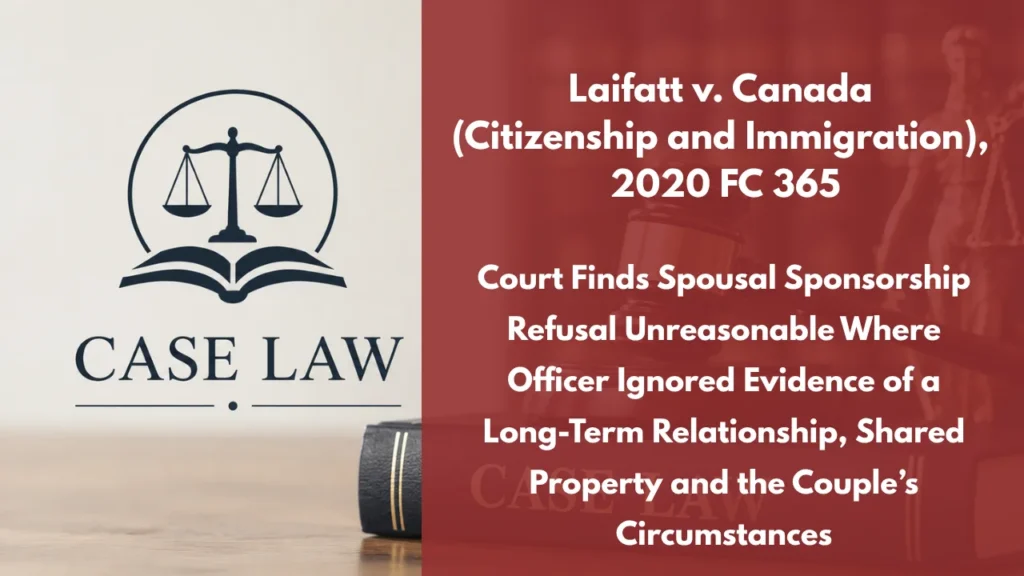
Orlando Laifatt sought judicial
review after an immigration officer refused his permanent residence application
under the Spouse or Common-law Partner in Canada Class. The officer was not
satisfied that his marriage to Canadian citizen Wing-Wan Chung was genuine and
not entered into primarily for immigration purposes under subsection 4(1) of
the Immigration and Refugee Protection Regulations. The Federal Court found
that the officer failed to properly consider important contradictory evidence
and did not provide justified reasons for the refusal.
Key Principle
A decision-maker assessing the
genuineness of a marriage must meaningfully engage with directly relevant
evidence that contradicts concerns about the relationship. Although an officer
need not discuss every document, silence regarding important contrary evidence
may support an inference that it was overlooked. The assessment must also be
responsive to the couple’s particular circumstances, including their age, life
stage and relevant cultural context, rather than relying on assumptions about
how spouses should organize their finances.
Background
Laifatt, a 76-year-old American
citizen born in Jamaica, had known Chung, a 70-year-old Canadian citizen, since
1966. Their families operated businesses across the street from each other in
Jamaica. Although they later moved to different countries, they remained in
contact for decades.
They reunited in Toronto in 2002
while Laifatt was caring for his terminally ill mother. In 2003, they purchased
a home in Markham and, according to Laifatt, began living together in a
conjugal relationship. He proposed in 2016, and they married in Miami in
January 2017 before having a wedding banquet and honeymoon.
Laifatt applied for permanent
residence in May 2017. Following an interview, the officer concluded that there
was insufficient evidence of a genuine relationship, joined affairs and
financial interdependency.
Court Findings
• Important Property Evidence
Was Overlooked
The officer relied on land
transfer documentation that did not list Laifatt, but failed to address a 2003
Land Registrar application identifying Chung as charger and Laifatt as chargee.
While this was not determinative proof of joint ownership, the Court found it
was critical evidence showing Laifatt had an interest in the Markham property.
Ignoring evidence pointing against the officer’s conclusion undermined the
reasonableness of the assessment.
• Financial Interdependency
Required Context
The Court found that the officer
failed to adequately consider the couple’s age and life stage. Both were
retired and had lived independently for many years, meaning their financial
arrangements could reasonably differ from those of a younger couple needing
greater financial integration. Chung also explained that her daughter largely
managed her banking activities.
• Cultural Evidence and
Overall Reasons Were Inadequate
Chung explained that, within her
Chinese culture, personal finances were not generally discussed. The officer
did not meaningfully engage with this explanation. More broadly, the reasons
selectively focused on evidence supporting concerns while failing to analyze
evidence supporting the relationship’s lengthy history and intermingling of
affairs. The resulting conclusion that the marriage was not genuine and was
primarily for immigration purposes lacked sufficient justification.
Outcome
The Court allowed the
application, set aside the refusal, and returned the permanent residence
application for redetermination by a different decision-maker. No question was
certified.
Case
Citation:
Laifatt v. Canada (Citizenship and Immigration), 2020 FC 365 (CanLII)
Prepared by:
Dr. Muhammad Abrar (Barrister and Solicitor)
Author | Writer | Mentor | Legal Researcher | Canadian Immigration Case Law and Statistics Analyst