


Outcome:
Judicial Review Dismissed
➢ Introduction
The Federal Court reviewed the refusal of a Hindu priest’s
application to restore his temporary resident status and obtain a work permit.
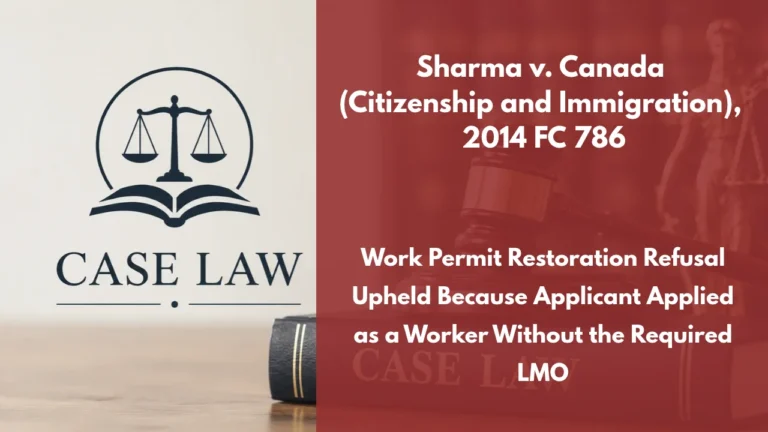
The Court upheld the refusal because the applicant
specifically applied for restoration as a worker and did not provide the
required Labour Market Opinion (LMO). Although he may have been able to remain
in Canada as a visitor and perform religious duties without a work permit, that
was not the basis on which he applied.
➢ Key Principle
An applicant must be assessed based on the status and
authorization actually requested in the application.
Where an applicant applies for restoration as a worker and
requests a work permit, the officer is not required to treat the application as
a request for restoration as a visitor simply because another regulatory
provision might have allowed the applicant to work without a permit.
An applicant cannot later rely on a different immigration
pathway simply because the pathway originally selected was unsuccessful.
➢ Background
The applicant was a Hindu priest who had lived and worked in
Canada since 2000.
For several years, he held visitor records that authorized
him to perform religious duties without a work permit under section 186(l)
of the IRPR. Beginning in 2009, however, he obtained successive work
permits.
His most recent work permit expired in June 2013. His
application to extend the work permit was refused because he did not provide a
valid LMO.
He then applied for restoration of temporary resident status
and a work permit as a worker. His representative stated that an LMO had been
requested and would be submitted once obtained.
The officer refused the application because no LMO had been
provided and concluded that the applicant was no longer eligible for
restoration.
➢ Court Findings
The Federal Court accepted that the applicant could
potentially have remained in Canada as a visitor and continued performing
religious duties under section 186(l) without a work permit.
However, that was not what he had requested.
The application specifically sought “restoration of
temporary resident status as a worker” and a work permit. The applicant’s
representative also expressly stated that the work permit application was based
on obtaining a positive LMO.
The Court therefore found it reasonable for the officer to
assess the application as a worker application rather than as an application
for visitor status.
The Court also rejected the argument that the applicant was
entitled to a work permit without an LMO under section 205(d). The Court found
that this exemption was not available in the circumstances because the
applicant was applying for a work permit after entering Canada under section
199(b), rather than making an application under section 200 to which the
exemption applied.
Although the applicant may have made a strategic mistake by
requesting worker status instead of restoration as a visitor, that mistake did
not make the officer’s decision unreasonable.
➢ Outcome
The Federal Court dismissed the application for judicial
review and upheld the refusal of restoration and the work permit.
Case Citation:
Sharma v. Canada (Citizenship and Immigration), 2014 FC 786 CanLII
Prepared by:
Dr. Muhammad
Abrar (Barrister and
Solicitor)
Author | Writer | Mentor | Legal Researcher | Canadian
Immigration Case Law and Statistics Analyst

Barrister & Solicitor
From temporary status to PR, get expert legal help to choose the right immigration pathway.








© 2026 A&M Canadian Immigration Law Corporation | All Rights Reserved.