

Logo of A&M Canadian Immigration law Corporation

Author name: amcaimredesign

Criminally Inadmissible
Criminal Inadmissibility

What Is Criminal Inadmissibility Under Canadian Immigration Law? (IRPA s. 36)

Canadian immigration law allows an individuals to be found inadmissible to Canada because of criminal record. This is affirmed in IRPA s. 36.  Source: IRPA s. 36 There are Two main categories 1) Serious criminality — IRPA s. 36(1) (PRs + foreign nationals) For serious criminality a person may be inadmissible if they: ●        were convicted in Canada of an offence that gives them a maximum penalty of 10+ years, or ●        they were convicted in Canada and received more than 6 months imprisonment, or ●        they were convicted outside Canada of an offence that is likely to be punishable in Canada by 10+ years, or ●        they committed an act outside Canada that could be punishable in Canada by 10+ years.  Source: IRPA s. 36(1)   2) Criminality (“ordinary criminality”) — IRPA s. 36(2) For general criminality a foreign national may be inadmissible if they: ●        were convicted in Canada of an indictable offence, or ●        they have received two convictions  which did not arise from the same incident, or ●        they were convicted outside Canada of an offence that is to be indictable in Canada, or ●        they committed an act outside Canada that is to be indictable in Canada.  Source: IRPA s. 36(2)   Call A&M Canadian Immigration Law Corporation: (204) 442-2786  If you are worried about whether you are inadmissible or have been refused at the border?We can provide document-based review can clarify whether IRPA s. 36 applies and what options you may have.  Source: IRPA s. 36 Frequently Asked Questions Could I be refused my study permit or work permit because of a foreign conviction? Yes—foreign convictions are likely to trigger inadmissibility if they match a Canadian offence under IRPA s. 36. Could I be refused even for a short visit?  Yes— for admissibility it is assessed at entry, even for any brief trips. Do I need two convictions to be inadmissible? Not necessarily. One conviction may be enough, depending on the offence and category. Latest News Can an Indecent Act in the U.S. Make You Criminally Inadmissible in Canadian Immigration? Read More Can Public Nudity or Indecent Exposure in the U.S. Lead to Criminal Inadmissibility in Canadian Immigration? Read More Can Sexual Assault in California, New York, or Minnesota Lead to Criminal Inadmissibility in Canadian Immigration? Read More Can Uttering Threats in California, New York, or Minnesota Lead to Criminal Inadmissibility in Canadian Immigration? Read More Can Voyeurism in the U.S. Lead to Criminal Inadmissibility in Canadian Immigration? Read More Deemed Rehabilitation for U.S. Citizens and U.S. Residents Entering Canada Read More Deemed Rehabilitation for U.S. Travelers: Why “10 Years From the Offence” Isn’t Always the Right Rule Read More Graffiti and Criminal Inadmissibility: Canada vs California, New York, Minnesota Read More Mischief (Vandalism) and Criminal Inadmissibility: Canada vs California, New York and Minnesota Read More
Criminal Inadmissibility

What Is a Temporary Resident Permit (TRP) for Criminal Inadmissibility in Canadian Immigration?

A Temporary Resident Permit (TRP) is designed to allow an otherwise inadmissible person to enter or remain in Canada temporarily.  Source: IRPA s. 24 Key points: ●        TRPs are for foreign nationals. ●        TRPs are discretionary. ●        TRPs do not permanently fix inadmissibility.  Source: IRPA s. 24   TRP plus work permit: if someone holds a TRP valid for 6 months or more, they may enter Canada as long as their work permit is approved in writing  but it has not been issued.  Source: IRPR s. 199(d) Call A&M Canadian Immigration Law Corporation: (204) 442-2786  If you must travel soon and inadmissibility is an issue, a TRP strategy may possibly allow you depending on timing and documents.  Source: IRPA s. 24 Frequently Asked Questions Is TRP guaranteed? No—TRPs are discretionary and depend on the officer’s assessment. Source: IRPA s. 24   Does a TRP permanently remove inadmissibility? No—it is temporary only. Latest News Can an Indecent Act in the U.S. Make You Criminally Inadmissible in Canadian Immigration? Read More Can Public Nudity or Indecent Exposure in the U.S. Lead to Criminal Inadmissibility in Canadian Immigration? Read More Can Sexual Assault in California, New York, or Minnesota Lead to Criminal Inadmissibility in Canadian Immigration? Read More Can Uttering Threats in California, New York, or Minnesota Lead to Criminal Inadmissibility in Canadian Immigration? Read More Can Voyeurism in the U.S. Lead to Criminal Inadmissibility in Canadian Immigration? Read More Deemed Rehabilitation for U.S. Citizens and U.S. Residents Entering Canada Read More Deemed Rehabilitation for U.S. Travelers: Why “10 Years From the Offence” Isn’t Always the Right Rule Read More Graffiti and Criminal Inadmissibility: Canada vs California, New York, Minnesota Read More Mischief (Vandalism) and Criminal Inadmissibility: Canada vs California, New York and Minnesota Read More

Criminal Inadmissibility

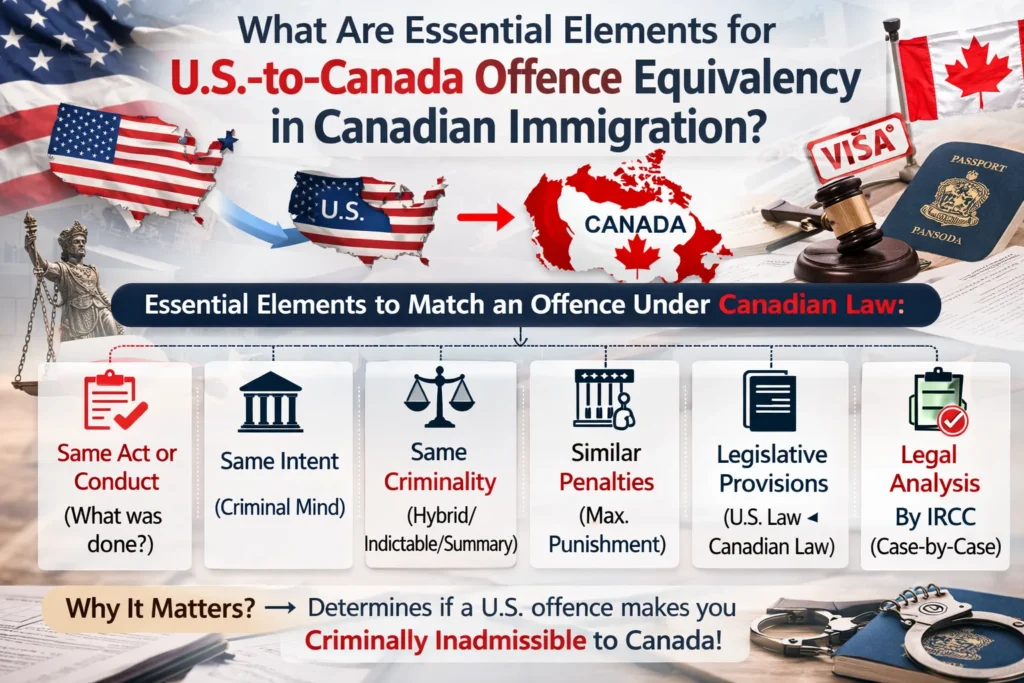
What Are Essential Elements for U.S.-to-Canada Offence Equivalency in Canadian Immigration?

Essential elements are the core legal ingredients that must be proven for an offence. In a criminal equivalency assessment (U.S. → Canada), officers compare the essential elements of the U.S. offence to the essential elements of the closest Canadian offence to see if they truly match. Source (equivalency approach): IRB Legal Concepts (Criminality/Equivalency)  Source (inadmissibility framework): IRPA s. 36   What counts as “essential elements” 1) Actus reus (the prohibited act) What the person did (or failed to do) that the law prohibits. ●        Example: “operated a motor vehicle” ●        Example: “took property that belonged to someone else” 2) Mens rea (the required mental state) What the person intended, knew, or was reckless/willfully blind about. ●        Example: “intended to take it” ●        Example: “knew it was stolen” ●        Example: “was impaired” (depending on the offence wording) These two ideas—actus reus and mens rea—are the backbone of most equivalency comparisons (your slide reflects this). Why essential elements matter for U.S.–Canada equivalency Offence names can be misleading. Two offences can sound the same but be legally different. An officer (or lawyer) asks: ●        Does the U.S. offence require the same act as the Canadian offence? ●        Does it require the same mental state? ●        Are there extra elements in one country that don’t exist in the other? If the U.S. offence is broader than the Canadian offence (covers more conduct), there may be no true equivalence unless the record proves facts that satisfy the Canadian elements. Source (equivalency comparison concept): IRB Legal Concepts (Equivalency)   What documents show the essential elements (U.S. cases) To do an equivalency review properly, the key documents are: ●        charging document (complaint / information / indictment) ●        statute text (the exact section you were charged/convicted under) ●        judgment / disposition ●        sentence order ●        if needed: agreed statement of facts, plea transcript, or police report (when admissibility is being assessed on “acts” or where the statute is broad) Officer guidance emphasizes document-based analysis for inadmissibility decisions.  Source: ENF 2 / OP 18 (Evaluating Inadmissibility)  Quick U.S. example (how a mismatch happens) ●        U.S. statute might criminalize “taking property” with very broad language. ●        Canadian theft requires taking or converting property with intent to deprive (a key mental element). If the U.S. conviction record doesn’t clearly establish that intent element, equivalency arguments become important Call A&M Canadian Immigration Law Corporation: (204) 442-2786 If you have a U.S. record, an equivalency review focuses on the essential elements and the court documents—often the difference between “inadmissible” and “not equivalent.” Latest News What Are Essential Elements for U.S.-to-Canada Offence Equivalency in Canadian Immigration? Read More Can a U.S. Domestic Abuse Offence Become Serious Enough to Cause Criminal Inadmissibility in Canadian Immigration? Read More Tran v. Canada (2017 SCC 50): Which Law Applies, and Why Does Timing Matter for Criminal Inadmissibility in Canadian Immigration? Read More How Does U.S.-to-Canada Criminal Equivalency Work in Canadian Immigration? A Detailed Guide Using Brannson and Hill. Read More How Do PR Removal and Serious Criminality Impact Canadian Immigration and Criminal Inadmissibility? Read More How Do Officers Determine Criminal Inadmissibility in Canadian Immigration Using U.S. Records? Read More For U.S. Cases, How Does “Convicted” vs “Committed an Act” Affect Criminal Inadmissibility in Canadian Immigration Inside vs Outside Canada? Read More Federal, Manitoba Provincial, and Youth Offences: What Counts for Criminal Inadmissibility in Canadian Immigration? Read More DUI / DWI Comparative Chart for Criminal Inadmissibility in Canadian Immigration: Canada vs. California (Los Angeles) vs. New York vs. Minnesota Read More





