A lot of people
use the phrase “apply
for citizenship” as if it means the same thing in every case. It does
not.
When it comes
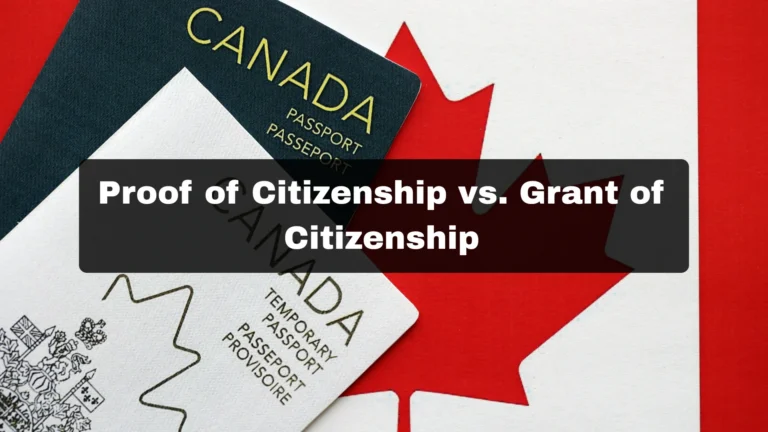
to Canadian citizenship, there is an important difference between a proof of
citizenship application and a grant of citizenship application. That
difference matters even more now because of Bill
C-3, which changed the first-generation limit rules on December 15,
2025.
What is
proof of citizenship?
A citizenship
certificate is proof that you are already a Canadian citizen. IRCC
describes it as a document that proves your Canadian citizenship. It is not a
travel document, but it can be used to apply for a Canadian passport and access
services and benefits.
This is the
process used when the real question is not “Can I become Canadian?” but rather
“Am I already Canadian under the law?” That is why proof of citizenship is so
important in descent cases. If you have a Canadian parent or grandparent, you
may already be a citizen, and IRCC specifically says that to find out for sure,
you should apply for a citizenship certificate.
What is a
grant of citizenship?
A grant of
citizenship is different. This is the process for someone who is not already a
Canadian citizen and wants to become one. For adults, IRCC says applicants
generally must be permanent residents, meet physical presence requirements,
file taxes if required, prove language ability in some cases, pass the
citizenship test if applicable, and take the oath.
So the simplest
way to think about it is this:
Proof of citizenship = you believe you are already Canadian, and you want
official confirmation.
Grant of citizenship = you are not yet Canadian, and you are applying to
become one.
How Bill C-3
fits in
This is where Bill
C-3 becomes very important.
IRCC says that
if you became a citizen because of Bill C-3, you must apply for a citizenship
certificate to find out for sure. In other words, many people affected by Bill
C-3 are not applying for a grant of citizenship at all. They may already be
citizens automatically under the amended law and just need proof.
That is
especially true for many people born outside Canada before December 15, 2025 in
the second generation or later. IRCC says citizenship may have been restored or
given to some of these people automatically. Those individuals would generally
be looking at proof of citizenship, not a grant.
On the other
hand, IRCC also says that some adopted people born and adopted outside Canada
in the second generation or later may need to apply through a direct grant process for adopted people. And if someone is not affected by Bill C-3 but
still wants to become Canadian, they would use the regular citizenship
application process instead.
People often
hear that Bill C-3 “lets them apply for citizenship,” but that wording can be
misleading.
In many cases,
the real legal issue is whether citizenship already exists. If it does, the
correct process is proof of citizenship. If it does not, then the person may
need a grant application, assuming they qualify through one of the available
routes.
That
distinction can make a big difference in strategy, documents, and expectations.
Bill C-3 did
not simply create a new path for everyone to become Canadian. For many people,
it changed their status directly. That is why the first question is often not
whether you can apply for citizenship, but whether you are already a citizen
and need proof of it.
If your case involves citizenship by descent, a
Canadian parent or grandparent, or questions about how Bill C-3 applies to your
family, it is worth getting proper guidance. A&M Canadian Immigration Law Corporation can help you understand which process fits your situation and guide
you in the right direction.