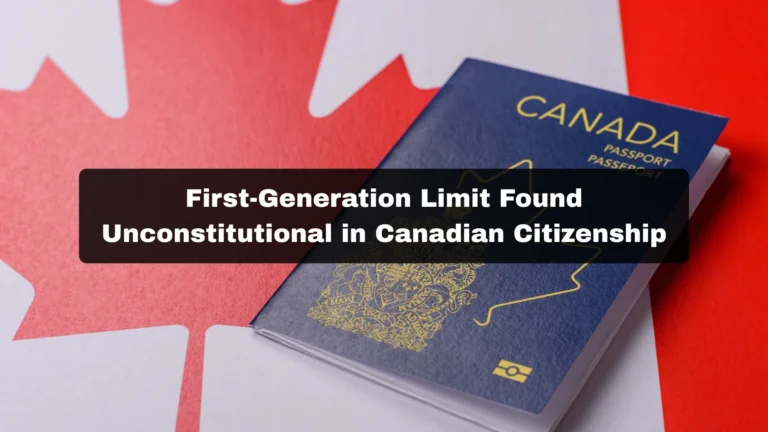
Canada’s old first-generation
limit on citizenship by descent was challenged in court, and it was
ultimately found to be unconstitutional. But why?
For many
people, this issue is not just legal. It directly affects whether they are
recognized as Canadian citizens.
What Was the
First-Generation Limit?
For years,
Canadian law placed a strict limit on citizenship by descent.
If you were
born outside Canada to a Canadian parent, you could often become Canadian. But
if your Canadian parent was also born outside Canada, citizenship usually
stopped there.
In other words,
citizenship was generally limited to only one generation born abroad.
At first
glance, this seemed like a clear rule. But over time, it created real problems.
The Problem
With the Rule
The issue was
not just about where someone was born. It was about unequal treatment
between Canadians.
Two Canadian
citizens could be treated very differently:
● A Canadian born in Canada could pass citizenship to
their child born abroad
● A Canadian born abroad might not be able to do the
same
Both were
Canadian. But the law treated them differently when it came to their children.
This raised an
important legal question:
Should all
Canadian citizens have the same ability to pass on citizenship?
Why It Was
Found Unconstitutional
The courts
looked at this issue through the lens of the Canadian Charter of Rights and
Freedoms, particularly equality rights.
The conclusion
was that the first-generation limit created unfair and unequal outcomes,
especially for families who had lived outside Canada for generations but still
maintained ties to the country.
In particular,
the rule could:
● disadvantage Canadians based on where they were born
● separate families by preventing citizenship from
passing down
● create inconsistent outcomes for people in very
similar situations
Because of
this, the court found that the rule did not meet constitutional standards.
What Changed
After the Decision
As a result of
these legal
challenges, the government introduced Bill
C-3, which came into force on December 15, 2025.
This law was
designed to fix the issues caused by the first-generation limit.
It allows
citizenship to extend beyond one generation in certain cases, especially for
people who were previously excluded.
At the same
time, the government introduced new rules for future generations, requiring a real
connection to Canada in some situations.
What This
Means in Practice
For many
people, this change is significant.
Some
individuals who were previously told they were not Canadian may now:
● qualify for citizenship
● or already be considered Canadian under the updated
law
At the same
time, the law still places conditions on how citizenship passes going forward.
So while the
old rule has been removed, the system is now more nuanced.
Final
Thoughts
The
first-generation limit was not just a technical rule. It had real consequences
for families and raised important questions about fairness.
Its removal
reflects a broader principle:
Canadian
citizenship should be applied in a way that is consistent and fair across
generations.
Speak With
A&M Canadian Immigration Law Corporation
At A&M
Canadian Immigration Law Corporation, we help individuals and families
understand how these legal changes affect their status.
If you were
previously told you did not qualify, or if your case involves a parent,
grandparent, or more complex family history, it may be worth revisiting your
situation.
Our team can
review your background and help you understand where you stand under the
current law.
Want to
learn more about your specific situation?
Citizenship by
descent can depend on many factors, including your family history, timing, and
how the law applied at each stage. You can explore our other articles to learn
more, or reach out to our team if you would like help understanding your
situation.