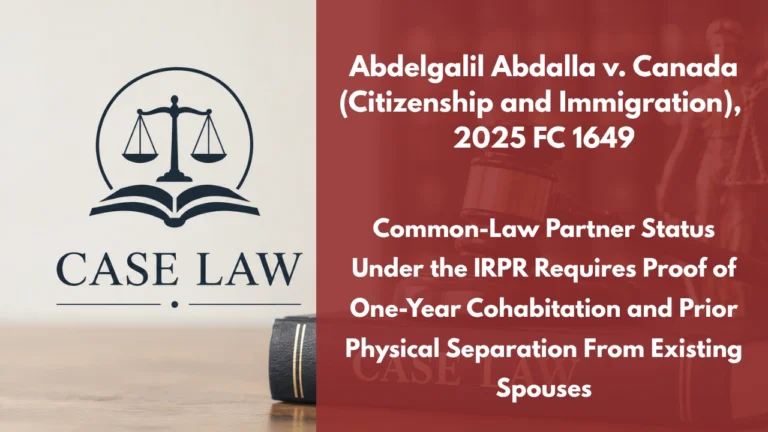
In Abdelgalil Abdalla v.
Canada (Citizenship and Immigration), 2025 FC 1649, the Federal Court
dismissed an application for judicial review concerning the Applicant’s
exclusion from the family class. The Officer was not satisfied that the
Applicant qualified as the common-law partner of his sponsor because he had
failed to establish that his previous marriages had broken down and that he had
lived separate and apart from his two wives for at least one year. The Court
found that the Officer reasonably assessed the evidence and that the Applicant
had failed to meet his evidentiary burden.
Background
The Applicant, a Sudanese citizen
residing in the UAE, remained legally married to two other women. He stated
that both relationships had ended in separation, but explained that the
marriages had not been legally dissolved because his former wives’ UAE residency
depended on remaining married to him.
The Applicant met the Sponsor in
2017 and claimed that they began living together as a common-law couple in
August 2017. They followed Islamic tradition and obtained a religious marriage
certificate in March 2021. The Sponsor subsequently travelled to Canada and was
granted refugee status. She later included the Applicant as her dependent
common-law partner in her permanent residence application.
The Officer raised concerns about
the Applicant’s continued marriages and the limited evidence establishing both
his separation from his other wives and his claimed common-law relationship.
The Applicant provided rental agreements, insurance documents and letters from
friends, but the Officer remained unsatisfied.
Key Principle
A person claiming common-law
partner status must establish both the required period of conjugal cohabitation
and the breakdown of any previous marriage or relationship. Where an
applicant remains legally married to other spouses, evidence of separation and
living separate and apart becomes particularly important.
An applicant bears the onus of
providing sufficient and reasonably available corroborating evidence to
establish the factual basis of the claim. Evidence of a romantic relationship
with a new partner does not, by itself, establish that previous marriages have
ended or that the applicant has lived separate and apart from those spouses for
the required period.
Court Findings
• Separation from Previous
Wives Was Not Sufficiently Established
The Court found that the
Applicant had not provided sufficient evidence demonstrating that he was no
longer living with either of his previous wives. The statement concerning
separation from his first wife did not provide separation dates or residential details,
while there was no declaration from his second wife confirming separation.
• Cohabitation Evidence Did
Not Resolve the Separation Issue
Although rental agreements and
other evidence supported the Applicant’s relationship with the Sponsor, this
evidence did not establish that he had physically separated from his previous
wives. The Officer was therefore entitled to conclude that the Applicant had
not demonstrated the required one-year period of separation and common-law
cohabitation.
• The Applicant Bore the
Evidentiary Burden
The Court emphasized that
applicants must provide clear evidence supporting their immigration claims. The
Officer was not required to accept unsupported assertions where additional
corroborating evidence was reasonably available. The Applicant’s failure to
provide sufficient documentary evidence was fatal to his claim.
• The Court Would Not Reweigh
the Evidence
The Applicant’s arguments
effectively invited the Court to reassess the evidence and reach a different
conclusion. The Court declined to do so, finding that the Officer’s decision
was transparent, intelligible and justified based on the totality of the evidence.
Outcome
The Federal Court dismissed
the application for judicial review and upheld the Officer’s decision. No
question for certification was raised or certified.
Case
Citation:
Abdelgalil Abdalla v. Canada (Citizenship and Immigration), 2025 FC 1649 (CanLII)
Prepared
by:
Dr. Muhammad Abrar (Barrister and Solicitor)
Author | Writer | Mentor | Legal Researcher | Canadian Immigration Case Law and
Statistics Analyst