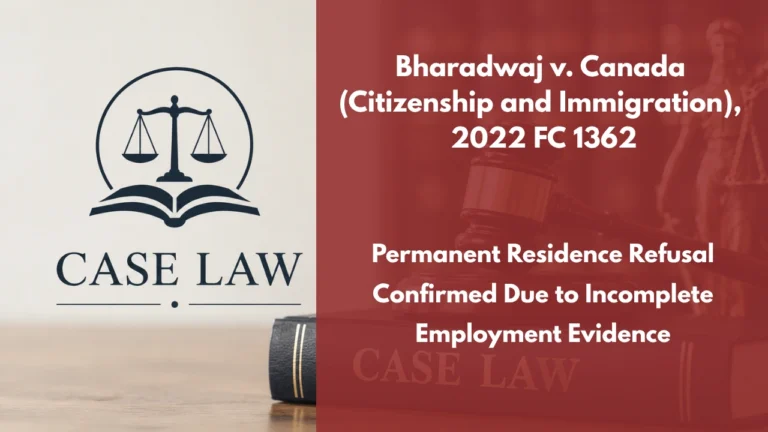
The Federal Court reviewed Rahul
Bharadwaj’s CEC PR refusal. The Senior Analyst found that his Rogers employment
letters did not establish at least one year of qualifying Canadian work
experience because they failed to connect his position, duties, and duration.
The Court upheld the decision.
Key Principle
A CEC applicant bears the burden
of proving qualifying Canadian work experience with evidence establishing the
position held, period of employment, and relevant duties. Where employment
letters are incomplete but not disbelieved, the concern is evidentiary
sufficiency rather than credibility, and procedural fairness does not require
an officer to invite the applicant to correct deficiencies before refusal.
Background
The applicant relied on Rogers
employment from January 2016 to September 2017 under NOC 6221. One letter
confirmed full-time employment and his current position as Consumer Inside
Sales Consultant but did not state how long he held it or describe duties. A
second undated letter listed duties but did not connect them to the position or
specify their duration.
Court Findings
• Employment Letters Left
Material Gaps
The first Rogers letter
identified the applicant’s current position but omitted duties and duration.
The second listed sales-related duties but was undated and did not connect them
to the Consumer Inside Sales Consultant position. Even read together, the
documents failed to establish that qualifying duties were performed for the
required one-year period.
• Officer Considered the
Letters Together
The applicant argued that the
Senior Analyst assessed each letter in isolation. The Court disagreed. The
decision letter and GCMS notes showed that both were considered individually
and collectively. Their combined contents still did not resolve the missing
information concerning position duration and the relationship between the
listed duties and that position.
• Applicant Bore the Burden of
Proving Eligibility
The applicant had to demonstrate
that his work experience satisfied CEC requirements. Because the evidence did
not establish that he performed qualifying duties for at least one year during
the relevant period, the Senior Analyst reasonably concluded that the
requirements were not met.
• No Procedural Fairness Duty
to Identify Deficiencies
The Senior Analyst did not doubt
the authenticity of the letters or the truthfulness of their contents. The
problem was incompleteness. Where concerns relate to sufficiency rather than
credibility or authenticity, an officer is not required to alert an applicant
to gaps or provide an opportunity to submit better evidence before refusal.
• Processing Delay Did Not
Invalidate the Decision
IRCC took about 15 months to
decide the application, exceeding the six-month guideline. Even assuming the
delay was excessive, the Court found no authority requiring a completed
decision to be set aside for that reason. Mandamus principles addressing delay
before a decision is made did not apply.
• Court Would Not Fill
Evidentiary Gaps
Judicial review examines whether
the decision was reasonable on the record before the decision-maker. The Court
would not infer missing employment facts or reconstruct the applicant’s work
history where the submitted letters failed to clearly establish the duration
and duties necessary for CEC qualification.
Outcome
The Federal Court dismissed
judicial review. The Senior Analyst reasonably found the employment letters
insufficient to prove qualifying CEC work experience, and no procedural
fairness breach arose from failing to request additional evidence. No question
was certified.
Case
Citation:
Bharadwaj v. Canada (Citizenship and Immigration), 2022 FC 1362 (CanLII)
Prepared by:
Dr. Muhammad Abrar (Barrister and Solicitor)
Author | Writer | Mentor | Legal Researcher | Canadian Immigration Case Law and Statistics Analyst