Introduction
The
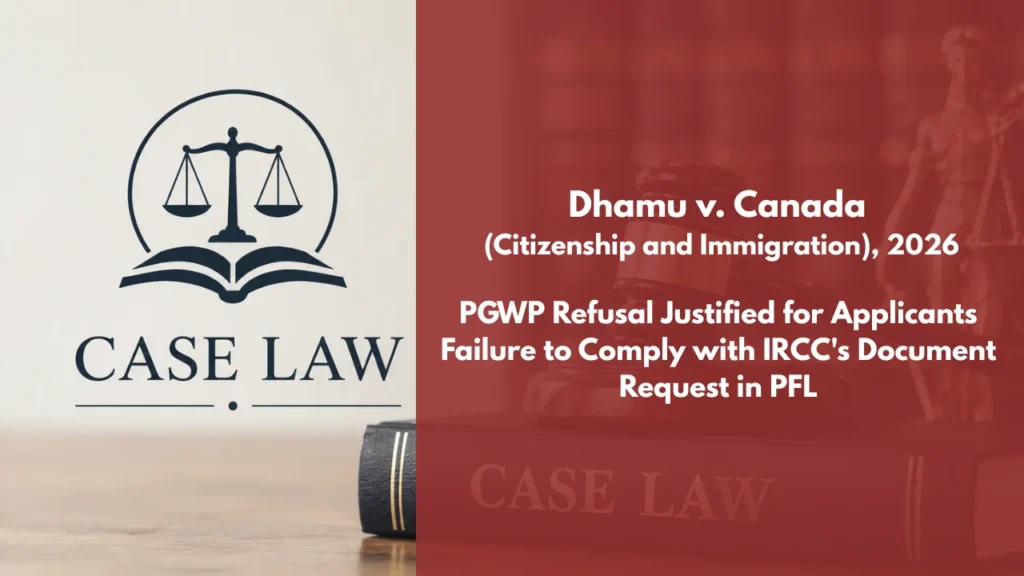
Federal Court reviewed the refusal of a Post-Graduation Work Permit (PGWP)
application after the applicant failed to provide a World Education Services
(WES) credential assessment requested in a procedural fairness letter. The
applicant argued that the requested document was unnecessary and unavailable
because WES does not assess her foreign vocational credential. The Court
dismissed the application, holding that the applicant failed to explain her
inability to provide the document or challenge the request before the officer.
Key
Principle
An
applicant who receives a procedural fairness request under section 16(1) of the Immigration and Refugee Protection Act must either provide the requested
documents or explain why compliance is impossible or unreasonable. An applicant
cannot successfully challenge the reasonableness of a document request on
judicial review when no such explanation or objection was provided to the visa
officer during processing.
Background
The
applicant, an Indian citizen, entered Canada as an international student and
completed a postgraduate diploma at St. Clair College. After applying for a
PGWP, the visa officer raised concerns regarding the foreign vocational
credential the applicant had relied upon to obtain her original study permit
and requested a WES credential assessment through a procedural fairness letter.
Instead of providing the requested assessment or explaining why it could not be
obtained, the applicant simply resubmitted her foreign educational documents.
The officer refused the application for failing to comply with section 16(1)
of the IRPA.
Court Findings
- Officer’s Document Request Was Relevant
The
Court held that the officer reasonably requested additional documentation
concerning the applicant’s foreign education. Although foreign credentials are
not part of the statutory requirements for PGWP eligibility, the officer was
entitled to examine the integrity of the applicant’s original entry into
Canada, making the request relevant under section 16(1) of the IRPA.
- Failure to Respond to the Procedural Fairness Letter Justified Refusal
The
Court emphasized that the applicant neither produced the requested document nor
explained why it was unavailable or impossible to obtain. She also failed to
argue before the officer that the request was unreasonable. Because the officer
could only assess the evidence and submissions actually provided, the finding
of non-compliance with the statutory duty of candour was reasonable.
- Judicial Review Cannot Rely on Explanations Never Given to the Officer
The
applicant argued before the Court that WES does not evaluate Indian vocational
diplomas. However, no evidence supporting this claim had been provided to the
officer during processing. The Court held that judicial review is confined to
the record before the decision-maker and cannot be used to introduce
explanations that were never presented to the officer.
Outcome
The
Federal Court dismissed the judicial review application, concluding that the
officer reasonably refused the PGWP application for failure to comply with section
16(1) of the IRPA after the applicant failed to provide the
requested document or explain why she could not do so.
Case Citation: Dhamu v. Canada (Citizenship and Immigration), 2026 FC 562 (CanLII)
Prepared by:
Dr. Muhammad Abrar (Barrister and Solicitor)
Author | Writer | Mentor | Legal Researcher | Canadian Immigration Case Law and Statistics Analyst