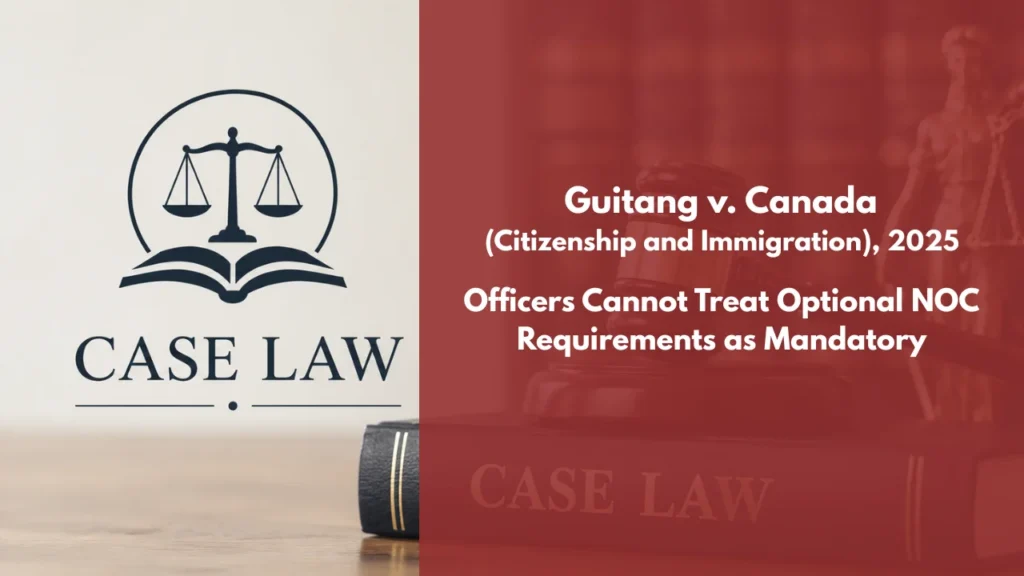
The
Federal Court reviewed the refusal of an LMIA-based work permit application for
a Personal Support Worker (NOC 44101) position. The officer concluded
that the applicant did not meet the job requirements because she lacked formal
caregiving training. The Court allowed the judicial review, finding that the
officer improperly relied on general NOC requirements instead of the specific
requirements contained in the LMIA and incorrectly treated optional NOC
qualifications as mandatory.
Key
Principle
The
Court reaffirmed that officers cannot treat optional NOC qualifications as
mandatory requirements and cannot substitute general NOC employment
requirements for the specific qualifications identified in an LMIA. Requirements described as “may be required” are not universal and must not
automatically be imposed on every applicant.
Background
Applicant
a citizen of the Philippines, applied for a work permit as a Personal Support
Worker. Her application was supported by a positive LMIA and evidence of her
experience as a domestic helper in Hong Kong, as well as her experience raising
three children as a single parent. The LMIA required only a secondary school
education and English language ability. It did not require formal caregiving
training, first aid certification, or home support courses.
The
officer nevertheless refused the application after relying on the employment
requirements listed in NOC 44101, including requirements that “may be
required,” such as home support courses, first aid certification, and
completion of a caregiving training program. Because the applicant had not
provided proof of formal caregiving training, the officer concluded that she
did not meet the job requirements.
Court
Findings
The
Federal Court found the decision unreasonable for two reasons.
First,
the officer improperly conflated the general employment requirements contained
in NOC 44101 with the specific requirements listed in the LMIA. While the NOC
provides a broad occupational framework, the LMIA sets out the qualifications
required by the employer for the specific position. The officer treated the NOC
requirements as if they formed part of the LMIA when they did not.
Second,
the Court held that the officer wrongly treated qualifications described in the
NOC as requirements that “may be required” as though they were
mandatory. The Court emphasized that terms such as “usually required” and
“may be required” do not mean “always required.” Since the employer did not
require formal caregiving training and the LMIA imposed no such condition, the
officer acted unreasonably in refusing the application on that basis.
Outcome
The Federal Court granted the application for judicial review, set aside the refusal decision, and returned the matter to a different officer for redetermination.
Case Citation: Guitang v. Canada (Citizenship and Immigration), 2025 FC 835 (CanLII)
Prepared by:
Dr. Muhammad Abrar (Barrister and Solicitor)
Author | Writer | Mentor | Legal Researcher | Canadian Immigration Case Law and Statistics Analyst