














Our Services
Contact Info
- +1 (204) 442-2786
- +1 (204) 416-9786
- doctor@amcaim.ca
- Unit 12, 1325 Markham Rd, Winnipeg, Manitoba R3T 4J6
© 2025 A&M Canadian Immigration Law Corporation | All Rights Reserved.
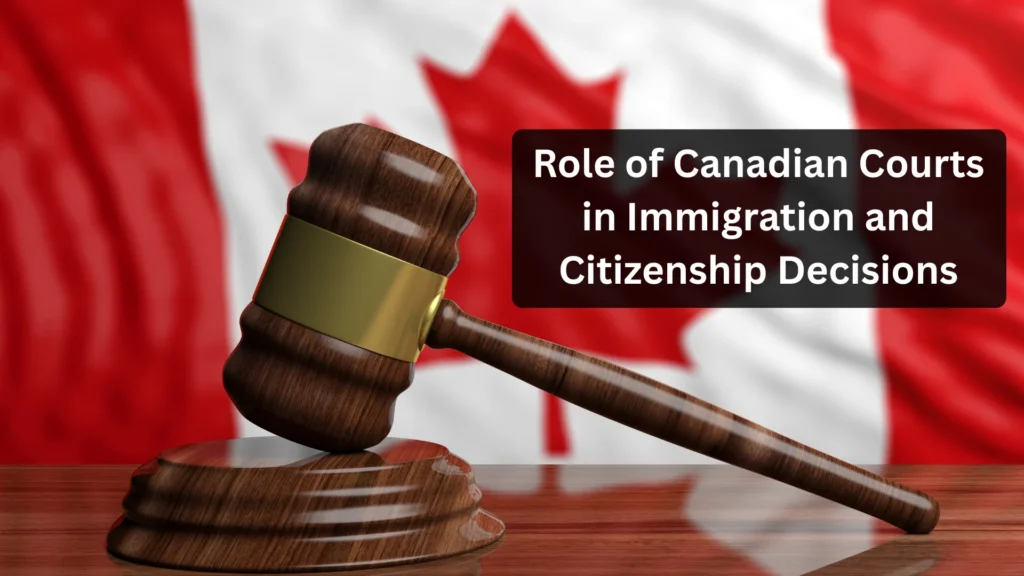
Administrative decisions in
immigration and citizenship matters can have major consequences for individuals
seeking to enter or remain in Canada. The courts are set in place to ensure
that government officials and administrative tribunals apply the law correctly
and follow fair procedures when making decisions.
Applicants are permitted to
come before the courts by way of judicial review or appeal, with matters
involving the Immigration and Refugee Protection Act (IRPA) and the
Citizenship Act. Judicial review allows the courts to inspect administrative
decisions made by the Immigration and Refugee Board of Canada, the Minister of Immigration,
and citizenship officers.
During judicial review, the courts determine whether the administrative process was fair and whether the decision was made in accordance with the law. Courts generally review questions of law and procedural fairness, rather than reassessing factual findings such as credibility of witnesses.
Federal Court and Court
of Appeal
The Federal Court could be
seen as a supervisor for the administrative actions of several immigration
authorities, including the Immigration and Refugee Board of Canada (IRB),
Immigration Refugees and Citizenship Canada (IRCC), and Canada Border Services
Agency (CBSA).
Individuals who wish to
challenge a decision, determination, or order under the IRPA may make an
application for leave to the Federal Court. There, a federal judge will either
grant or deny leave for judicial review. Additionally, whether it is the
minister or individual challenging the decision, the statutory time limit to
seek judicial review is 15 days for decisions made in Canada and 60 days for
decisions made outside Canada.
Under section 18.1(4) of the
Federal Courts Act, the court may review a decision if the decision-maker:
– Acted
without jurisdiction
– Failed to
observe a principle of natural justice or procedural fairness
– Made an
error of law
– Based its
decision on an unreasonable finding of fact
– Acted, or
failed to act, because of fraud or perjured evidence
– Acted in
any other way that was contrary to law.
Under judicial review of an
IRB decision, may either overturn the IRB decision, uphold the IRB decision, or
send the matter back for redetermination by a different member or panel.
If a party is dissatisfied
with the Federal Court’s decision, leave for appeal may be sought from the
Federal Court of Appeal. Representation before these courts is limited to
licensed lawyers; non-lawyers such as immigration consultants and paralegals are not authorized to represent clients as per the Federal Courts Act, s11;
Federal Courts rules, s119).
Supreme Court of Canada
The Supreme Court of Canada
is the final court of appeal from all other Canadian courts on all subject
matters, once all other avenues of appeal have been exhausted. If a party is not satisfied with a Federal Court of Appeal decision,
they have the right to seek leave to appeal to the Supreme Court, under section
40(1) of the Supreme Court Act.
The Supreme Court may grant leave to appeal:
o The case
involves a question of public importance
o It raises
an important issue of law or mixed law and fact
o The matter is, for any other reason, significant enough to be considered by the Supreme Court
Overall, courts act as a check on government and
administrative tribunals’ authority, ensuring that immigration and citizenship
decisions are lawful, fair, and consistent with Canadian legal principles. Contact A&M Canadian Immigration Law Corporation to help ensure your application
proceeds smoothly and that all your immigration-related needs are properly
addressed.
© 2025 A&M Canadian Immigration Law Corporation | All Rights Reserved.
Chat with Us