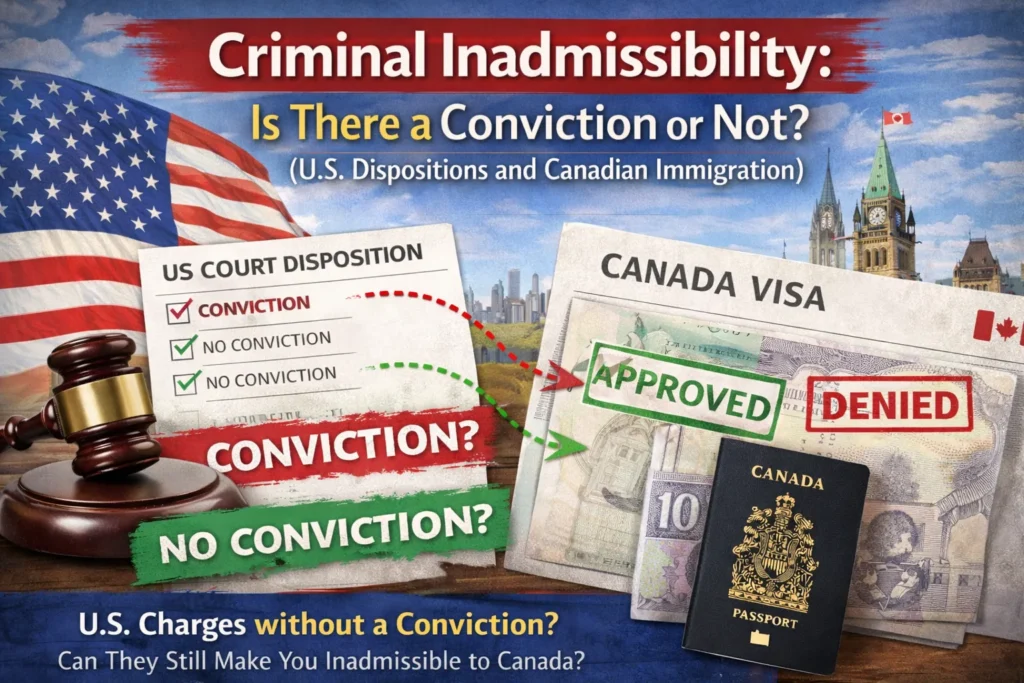
When travelling to Canada (or applying for a study/work permit), the
question is often not “Was it a felony or misdemeanor?”—it’s whether
Canadian immigration will treat the U.S. outcome as a conviction for
admissibility purposes. Officers assess this under the criminal inadmissibility
framework in IRPA s. 36, using policy guidance such as ENF 2 / OP 18.
Why this
matters
● A result treated as a conviction can trigger
inadmissibility under IRPA s. 36 (foreign convictions).
● Even without a conviction, Canada can sometimes
assess “committed an act” (outside Canada) based on evidence—so
non-conviction outcomes still require careful review.
Common U.S.
disposition terms: how they’re often treated
Important: These are general interpretations from
officer guidance; outcomes are document-driven and fact-specific.
Typically
treated as a conviction (for screening)
● Deferral of sentence (often treated like a conviction/suspended sentence
outcome if the offence equates to Canadian law).
● Nolo contendere (no contest) (often treated like a guilty plea with a conviction
result).
● Convicted of several counts (multiple convictions; counts may align to Canadian
charges).
Typically
treated as not a conviction (or not relied on as a conviction)
● Acquittal contemplating dismissal (not a conviction; often treated similarly
to a conditional discharge conceptually in guidance).
● Deferral of prosecution (generally not a conviction; often compared to a
stay of proceedings conceptually).
● Deferral of judgment (generally not a conviction; depends on final
judgment/outcome).
● Deferral of conviction (generally treated as not a conviction; often
compared to a conditional discharge conceptually).
● Nolle prosequi (generally not a conviction; often compared to a
stay of prosecution conceptually).
● Conviction overturned on appeal (not a conviction after reversal).
Special
issue: sealed records
A sealed record
can still be relevant. Officers may ask what the sealed record represents
(e.g., youth matter vs adult conviction) and evaluate based on the
circumstances and available proof.
What
documents are usually needed (U.S. cases)
To determine
“conviction or not,” officers and counsel typically need:
● the exact statute/section and wording
● charging document (complaint/information/indictment)
● judgment/disposition and sentence order
● proof all terms are complete
(fines/probation/classes)
● any appeal result or order setting aside the
outcome
Consult
A&M Canadian Immigration Law Corporation: (204) 442-2786
If your U.S. paperwork uses terms
like deferral, nolo contendere, nolle prosequi, sealed
record, or dismissal, a document-based review can clarify whether
Canada will treat it as a conviction and whether IRPA s. 36 may apply.
Disclaimer
(Educational Use Only)
This content is
for general educational information only and is not legal advice.
Immigration laws, regulations, policies, and officer practices can change,
and results depend on the specific facts and official records. Consult a
qualified Canadian immigration lawyer for advice about your situation.
Sources
● IRPA s.
36 (Criminal inadmissibility)
● ENF
2 / OP 18 (Evaluating Inadmissibility) PDF (archived copies)
Written by:
Dr. Muhammad Abrar (Barrister and Solicitor)
Author | Writer | Mentor | Legal Researcher | Canadian Immigration Case Law and Statistics Analyst
Frequently Asked Questions
A dismissal is
not a conviction, but Canada may assess admissibility through IRPA s. 36 using
convictions or (in some cases) the “act committed outside Canada” route based
on evidence.
Not usually. “Nolo contendere” is commonly treated like a guilty plea outcome for screening purposes.
Not
automatically—until it is overturned, it may still be treated as a conviction
for screening.