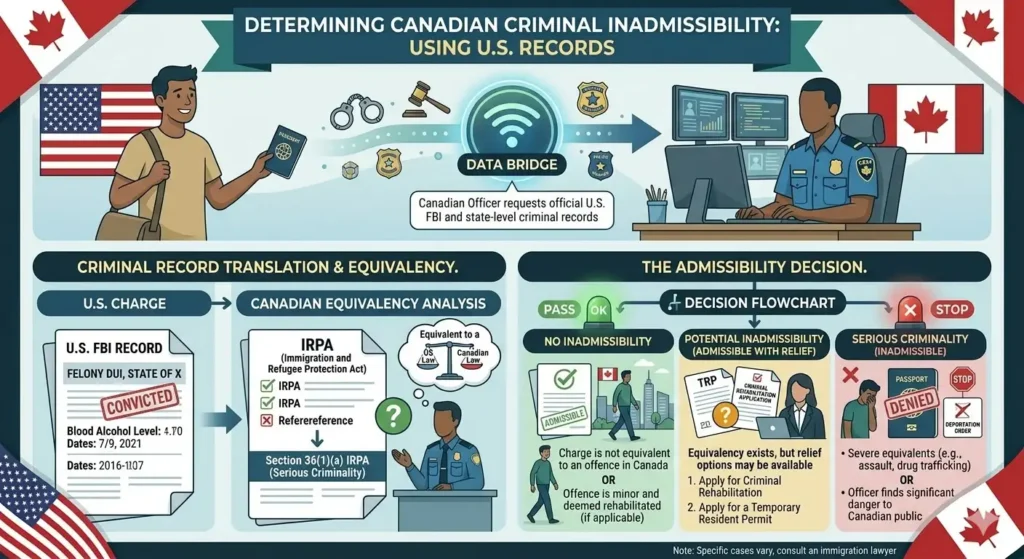
Canadian border
and immigration officers do not rely on U.S. labels like “misdemeanor” or
“felony.” They assess what the offence is in Canadian law (criminal
equivalency), then apply IRPA s. 36 to decide whether you may be
inadmissible.
Source: IRPA s.
36
Source: IRB
Legal Concepts (Equivalency)
Step 1 — Is
it a conviction or a non-conviction outcome?
Officers first
confirm whether the U.S. record shows a conviction (or something treated like
one).
Often still
treated as a conviction for screening purposes (examples):
● Suspended sentence
● Conviction under appeal (until overturned)
● Conviction in absentia
Source: ENF
2 / OP 18
Often
treated as “not a conviction” (document-dependent):
● Conviction overturned on appeal
● Absolute/conditional discharge (Canadian concept)
● Expungement/pardon (legal effect must be reviewed)
Source: ENF
2 / OP 18
Step 2 — Do
the “equivalency” test using the essential elements
Equivalency
compares the essential elements of the U.S. offence to the closest
Canadian offence, including:
● Actus reus (the prohibited act), and
● Mens rea (the required mental state: intent/knowledge/recklessness).
Source: IRB
Legal Concepts (Equivalency)
Why this
matters: if a U.S. statute
is broader than the Canadian offence, officers may look to reliable court
records to determine whether the proven facts match the Canadian elements.
Source: IRB
Legal Concepts (Equivalency)
Step 3 —
Apply the correct IRPA s. 36 category
After
identifying the Canadian equivalent offence, officers assess inadmissibility
under IRPA s. 36:
● Serious criminality (IRPA s. 36(1)) may apply if the Canadian equivalent is
punishable by a maximum of 10 years or more (common trigger for foreign
convictions).
● Ordinary criminality (IRPA s. 36(2)) applies to foreign nationals and often turns
on whether the Canadian equivalent is indictable (and hybrid offences
are treated as indictable for immigration).
Source: IRPA s.
36
Step 4 — Why
DUI/DWI is a frequent border issue
Impaired
driving is one of the most common problems for U.S. travellers. IRCC
specifically warns that if you’ve been convicted of impaired driving, you may
be inadmissible (including serious criminality depending on the circumstances).
Source: IRCC
impaired driving
Step 5 — The
documents that usually decide the outcome (U.S.)
Equivalency and
inadmissibility decisions are document-driven. Commonly important documents
include:
● Charging document (complaint/information/indictment)
● The exact statute section + wording
● Judgment/disposition
● Sentence order + proof all terms were completed (probation, fines,
classes, driving bans)
- Any appeal outcome or order setting aside the conviction
Consult
A&M Canadian Immigration Law Corporation If you have a U.S. record, a document-based equivalency
review can clarify whether IRPA s. 36 may apply and what options may be
available.
Source: IRPA s.
36
Disclaimer
(Educational Use Only)
This content is
provided for general educational and informational purposes only and
does not constitute legal advice. Canadian immigration laws, policies,
and officer practices can change at any time, and outcomes depend on the
specific facts of each case and the official records available. For advice
about your situation, consult a qualified Canadian immigration lawyer.
Sources
(hyperlinks)
● IRB
Legal Concepts (Equivalency) PDF
● ENF
2 / OP 18 (Evaluating Inadmissibility) PDF
Written by:
Dr. Muhammad Abrar (Barrister and Solicitor)
Author | Writer | Mentor | Legal Researcher | Canadian Immigration Case Law and Statistics Analyst