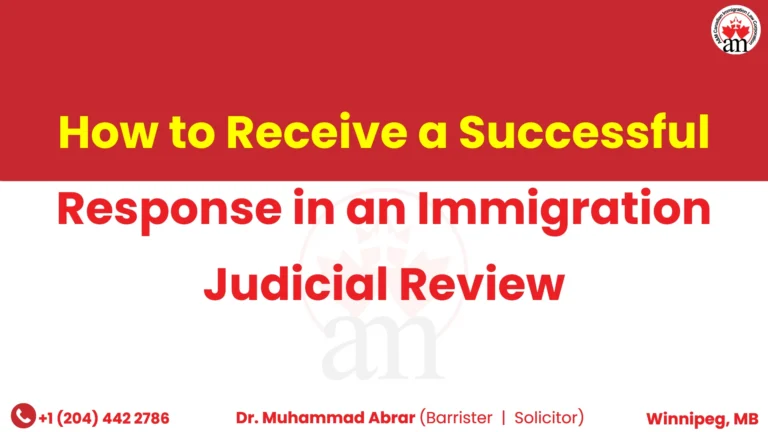
Judicial Review for a Canadian SOWP Refusal: What You Need to Know
A refusal of a Spousal
Open Work Permit (SOWP) (sometimes written as “SWOP”) can disrupt family
plans and create uncertainty about staying together in Canada. In most cases,
there is no traditional “appeal” for an IRCC work permit refusal. The main
court remedy is judicial review in the Federal Court of Canada.
A SOWP judicial review is not a new application and not a second assessment of eligibility. The Court
does not decide whether you “should” receive a permit. Instead, it reviews
whether the officer’s decision was reasonable and whether the process
was procedurally fair.
Start with a strong SOWP
record
Judicial review is driven by
what was actually submitted to IRCC. After a refusal, it is essential to
review:
the full application package and supporting
evidence filed with IRCC, and
the refusal reasons (and notes, if available).
It is also important to
confirm eligibility under IRCC’s current SOWP instructions (including recent
changes affecting eligibility for family members of foreign workers).
Key steps in a SOWP
judicial review
Confirm strict deadlines: generally 15 days (decision made in Canada) or
60 days (outside Canada).
File an Application for Leave and for Judicial
Review: the Court must first
grant “leave” (permission).
Prepare and file the Applicant’s Record: affidavits (if needed) and written legal
arguments under Federal Court rules.
Possible settlement after filing the record: in strong cases, the matter may resolve without
a hearing (for example, by consent to return the file to IRCC for
reconsideration).
Leave decision and (if granted) hearing: if leave is refused, the case ends; if granted,
the Court may schedule a hearing.
Legal representation is
strongly recommended
Federal Court judicial
review is complex litigation with strict rules and technical requirements. Self-representation
is not recommended, because missed deadlines or procedural mistakes can
harm the case and create avoidable issues later. A well-versed lawyer can
identify reviewable errors, prepare a compliant record, and pursue settlement
where appropriate.
At A&M Canadian Immigration Law Corporation, we provide
litigation-focused representation in judicial review immigration cases in Winnipeg and across Canada, and we help clients build stronger applications
to reduce refusals.