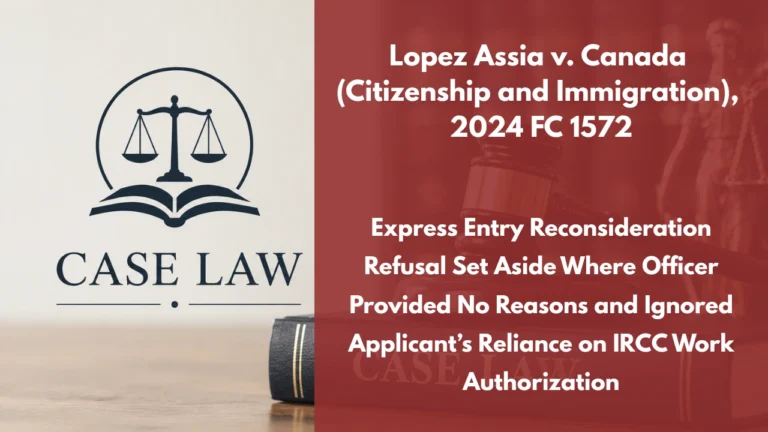
The Federal Court reviewed IRCC’s
refusal to reconsider the rejection of Ana Ines Lopez Assia’s Canadian
Experience Class permanent residence application. The original application was
refused because certain Canadian work experience was not counted, as the
applicant did not have valid temporary resident status during that period. In
requesting reconsideration, she argued that IRCC correspondence concerning a
post-graduation work permit public policy had led her to believe she was
authorized to continue working. The Court granted judicial review because the
reconsideration refusal was entirely conclusory and did not explain why her
circumstances were insufficient to reopen the decision.
Key Principle
Although immigration officers
have discretion to decline reconsideration requests, they must provide an
intelligible explanation where an applicant raises a central argument based on
unusual circumstances or the interests of justice. A statement that all
information was reviewed and that insufficient grounds exist is not enough
where the applicant alleges that IRCC’s own correspondence induced a reasonable
belief that continued work was authorized. The Minister cannot cure deficient
reasons on judicial review by supplying the analysis the officer should have
provided.
Background
The applicant was a Colombian
citizen who came to Canada as an international student, graduated from Seneca
College, and received a post-graduation work permit.
She later received correspondence
from IRCC advising that she might qualify for a facilitation measure under a
PGWP public policy and an interim authorization permitting her to continue
working until May 31, 2023.
In January 2023, she was invited
to apply for permanent residence under the Canadian Experience Class. She
claimed Canadian work experience acquired between November 2018 and March 2023.
IRCC excluded the period from
August 2022 to March 2023 because she lacked valid temporary resident status
and concluded that her recalculated Comprehensive Ranking System score fell
below the invitation threshold.
In her reconsideration request,
she acknowledged the status issue but explained that IRCC correspondence had
led her to believe she could lawfully continue working. She also referred to
the impact removal would have on her Canadian-born daughter.
Court Findings
• Reconsideration Decision Contained No Meaningful
Reasons
The Court held that the officer’s reconsideration decision was entirely
conclusory. Simply stating that all of the applicant’s information had been
reviewed and that insufficient grounds existed for reconsideration did not
satisfy the duty to provide transparent, intelligible, and justified reasons.
• Officer Failed to Address the Applicant’s Central
Argument
The applicant argued that IRCC’s own correspondence regarding the
Post-Graduation Work Permit public policy led her to reasonably believe she was
authorized to continue working in Canada. The Court found that the officer
failed to engage with this key submission, even though it formed the primary
basis of the reconsideration request.
• Applicant Was Entitled to an Explanation
Even when deciding whether to reopen a previous decision, an officer must
explain why the circumstances do not warrant reconsideration in the interests
of justice or as unusual circumstances. The absence of any analysis prevented
the applicant from understanding why her request had been refused and rendered
the decision unreasonable.
• Minister Could Not Cure the Deficient Reasons
During judicial review, the Minister argued that the PGWP public policy never
restored the applicant’s temporary resident status and that maintaining status
remained her responsibility. The Court held that this explanation could not
replace the officer’s missing reasons because it was the officer—not the
Minister—who was required to provide that analysis in the original decision.
• Remaining Issues Were Unnecessary to Decide
Because the officer’s failure to provide adequate reasons was sufficient to set
aside the reconsideration decision, the Court found it unnecessary to determine
the applicant’s humanitarian and compassionate submissions or her procedural
fairness arguments. The matter was returned to a different decision-maker for
reconsideration.
Outcome
The Federal Court granted
judicial review and returned the reconsideration request to a different
decision-maker. No question was certified.
Case Citation:
Lopez Assia v. Canada (Citizenship and Immigration), 2024 FC 1572 (CanLII)
Prepared by:
Dr. Muhammad Abrar (Barrister and Solicitor)
Author | Writer | Mentor | Legal Researcher | Canadian Immigration Case Law and Statistics Analyst