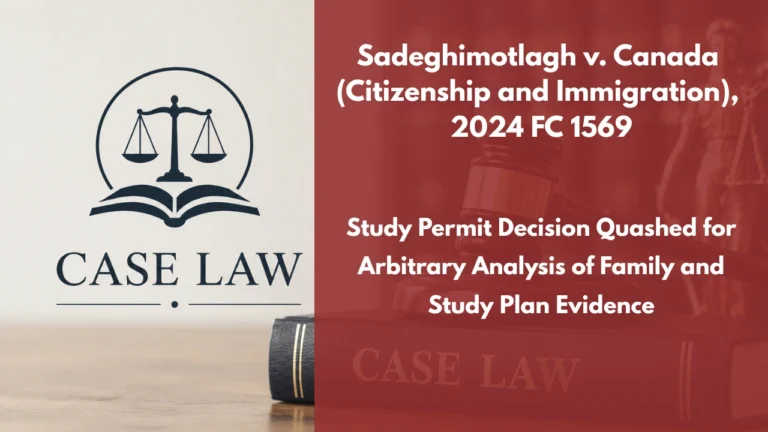
The Federal Court reviewed IRCC’s
refusal of Melika Sadeghimotlagh’s study permit application. The 21-year-old
Iranian applicant had been accepted into a four-year Bachelor of Science
program in Psychology at York University. The officer concluded that her family
ties were insufficient, her study plan was vague, and she had not demonstrated
the academic ability or career benefit necessary to justify the studies. The
Court granted judicial review because the officer ignored evidence that her
entire immediate family remained in Iran and provided no intelligible
explanation for finding the study plan inadequate.
Key Principle
An officer assessing home-country
ties must consider the actual evidence of the applicant’s family circumstances.
Being young, single, mobile, and without dependants does not reasonably
establish weak ties where the applicant will travel alone and both parents and
all siblings remain in the home country. If an officer finds a study plan vague
or academically unsupported, the reasons must briefly explain what information
was missing and why the evidence provided was insufficient.
Background
The applicant intended to study
Psychology at York University. Her parents, brother, and sister all lived in
Iran, and there was no evidence that she had any family in Canada.
She explained that she was
closely attached to her family and, under cultural expectations, continued to
live with them while unmarried. She stated that she intended to return to Iran
after graduation.
Her study plan explained that an
international degree would provide a competitive advantage in Iran,
particularly given the challenges faced by women in the workplace. She also
expressed a desire to contribute to her community and support positive change.
The applicant submitted York
University’s acceptance letter, proof of paid tuition, and her TOEFL results.
The officer nevertheless found
her family ties insufficient, described the study plan as vague, and stated
that transcripts had not been provided to establish academic proficiency.
Court Findings
• Family-Ties Finding Contradicted the Evidence
The Court held that the officer failed to meaningfully consider that the
applicant would travel to Canada alone while both of her parents, her brother,
and her sister remained in Iran. This evidence directly contradicted the
conclusion that she had insufficient family ties to her home country, rendering
the analysis unreasonable.
• Lack of Dependents Was an Unreasonable Negative Factor
The Court found that the officer relied on the applicant being young, single,
mobile, and without dependents without explaining why those characteristics
increased the likelihood that she would remain in Canada. There was no rational
basis for expecting a 21-year-old student with clear educational ambitions to
have dependents, making this factor arbitrary.
• Study Plan Was Not Meaningfully Assessed
The applicant explained that a Psychology degree from York University would
provide a competitive advantage in Iran, particularly in light of the workplace
barriers faced by women, and that she intended to return home to contribute to
her community. The Court held that the officer failed to engage with these
specific explanations before dismissing the study plan as vague.
• Finding That the Study Plan Was Vague Was Unexplained
The Court held that although the officer characterized the study plan as vague,
no reasons were given identifying what information was missing or why the
evidence submitted was inadequate. Without an intelligible explanation, the
conclusion lacked the justification required under Vavilov.
• Academic Proficiency Finding Lacked a Rational Basis
The Court found that the officer questioned the applicant’s academic ability
because transcripts had not been submitted, despite her acceptance into an
accredited Canadian university and evidence of English-language proficiency
through TOEFL results. The officer failed to explain why additional academic
documents were necessary, rendering this aspect of the decision unreasonable.
Outcome
The Federal Court granted
judicial review, set aside the study permit refusal, and returned the matter to
a different officer for redetermination. No question was certified.
Case Citation:
Sadeghimotlagh v. Canada (Citizenship and Immigration), 2024 FC 1569 (CanLII)
Prepared by:
Dr. Muhammad Abrar (Barrister and Solicitor)
Author | Writer | Mentor | Legal Researcher | Canadian Immigration Case Law and Statistics Analyst