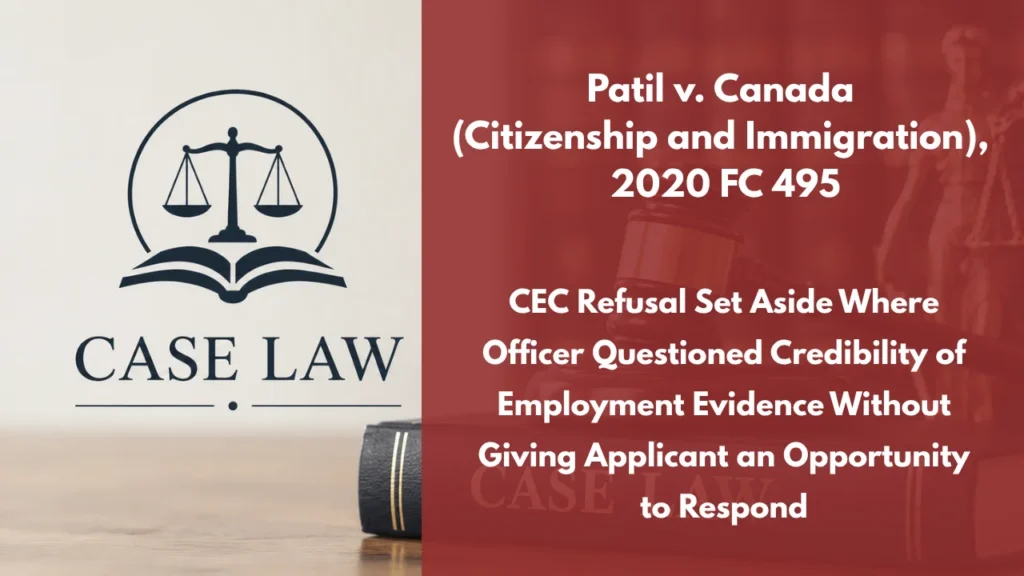
Dakshesh Kishor Patil sought
judicial review after an immigration officer refused his Canadian Experience
Class permanent residence application. The officer doubted that Patil had
genuinely worked as a gas station supervisor under NOC 6211 because he continued
to earn minimum wage after his promotion. The Federal Court found that the
officer’s concern went beyond the sufficiency of the evidence and effectively
questioned the credibility and authenticity of Patil’s employment evidence.
Procedural fairness therefore required that he be given an opportunity to
respond.
Key Principle
An immigration officer is
generally not required to alert an applicant to deficiencies or insufficiencies
in the evidence submitted with an application. However, where the officer’s
concern relates to the credibility, veracity, or authenticity of the applicant’s
evidence, procedural fairness may require that the applicant be given an
opportunity to respond. An officer cannot effectively reject an employment
letter as unreliable based on an adverse credibility inference without first
putting that concern to the applicant.
Background
Patil, an Indian citizen, came to
Canada as a student in 2015 and completed his studies at Centennial College in
December 2016. He later received a post-graduation work permit.
He began working part-time at a
Shell gas station as an attendant and moved to full-time employment in February
2017. On May 1, 2017, he was promoted to a Sales Supervisor position. Patil’s
wage nevertheless remained at the applicable provincial minimum wage and
increased only when Ontario’s minimum wage increased.
He was invited to apply for
permanent residence under the Canadian Experience Class in July 2018 and relied
on more than one year of work experience as a gas station supervisor under NOC
6211.
The officer refused the
application because Patil continued to earn minimum wage and therefore
concluded that, on a balance of probabilities, his employment did not
correspond to NOC 6211.
Court Findings
• Officer’s Concern Was About
Credibility, Not Merely Sufficiency
The GCMS notes expressly stated
that “there may be concerns regarding client’s credibility.” The officer
questioned why a supervisor would earn the same amount as the sales associates
he allegedly supervised and also expressed concerns about the timing of changes
to his pay stubs and similarities between his employment letter and explanation
letter.
The Court found that these
concerns went beyond simply finding that Patil had failed to provide enough
evidence. The officer was effectively questioning whether the claimed promotion
and employment were genuine.
• Employment Letter Was Direct
Evidence of the Claimed Position
Patil submitted an employment
letter stating that he worked as a gas station supervisor, listing his duties
and confirming his wage of $14 per hour plus benefits. There was no finding
that the stated duties failed to correspond to the claimed NOC.
The Court emphasized that there
is no general rule requiring multiple employment documents where one employment
letter accurately and completely sets out the applicant’s duties.
• Wage Alone Could Not Be Used
to Impugn Evidence Without Fairness
The officer effectively rejected
the employer’s evidence because Patil earned minimum wage. The Court found that
this amounted to an adverse credibility assessment. Once the officer used
Patil’s wage to question whether the employment letter and claimed supervisory
role were genuine, Patil should have been given an opportunity to explain.
The Court also rejected
speculative assumptions about why Patil had not changed employers or negotiated
a higher wage. Individuals may not necessarily have the ability to change jobs
easily or obtain higher wages simply because they receive a promotion.
Outcome
The Federal Court granted
judicial review, set aside the permanent residence refusal, and remitted the
matter to a different decision-maker for redetermination. No question was
certified.
Case
Citation:
Patil v. Canada (Citizenship and Immigration), 2020 FC 495 (CanLII)
Prepared by:
Dr. Muhammad
Abrar (Barrister and
Solicitor)
Author | Writer | Mentor | Legal Researcher | Canadian Immigration Case Law and
Statistics Analyst