The Federal
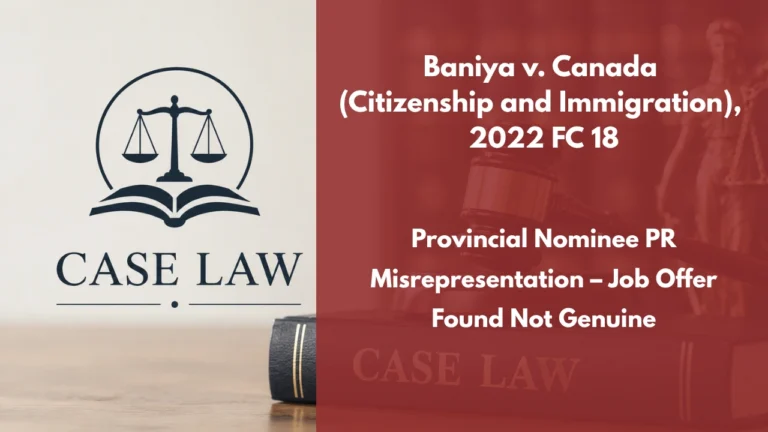
Court reviewed a finding that Wajdi Jaber Baniya Baniya was inadmissible for
misrepresentation in his Provincial Nominee PR application. The officer
concluded that the employment offer supporting his nomination was not genuine
when he applied for PR in 2018. The Court found the decision reasonable based
on multiple investigations and the applicant’s response.
Key
Principle
A misrepresentation finding carries serious consequences and must rest
on clear and convincing evidence. An intention to deceive is not required.
Where an officer assesses investigative evidence, gives the applicant an
opportunity to respond, considers evidence both supporting and undermining the
allegation, and reasonably concludes that a material job offer was not genuine,
the Court will not reweigh that assessment.
Background
The
applicant relied on a 2016 construction supervisor job offer from Vision Glass
to obtain a provincial nomination and later apply for PR. IRCC and provincial
investigations raised concerns that Vision Glass was no longer operating. The
nomination was cancelled, and the officer found that the 2018 PR application
contained a material misrepresentation because the employment offer was not
genuine.
Court
Findings
• Clear and
Convincing Evidence Standard Was Met
The Court
accepted that misrepresentation findings require clear and convincing evidence
because of their serious consequences, including a five-year inadmissibility
period. The officer did not rely on speculation. Instead, the conclusion was
supported by IRCC and provincial investigations, the company’s lack of
operations at its listed address, inactive website and contact information, and
the absence of evidence showing ongoing business activity.
• Prior LMIA
and Provincial Nomination Were Considered
The
applicant argued that the earlier positive LMIA and provincial nomination
supported the legitimacy of the employment offer. The officer expressly
considered those approvals but reasonably distinguished them from the question
before IRCC: whether the offer remained genuine when the applicant submitted
his PR application in 2018. The earlier approvals did not conclusively
establish continued validity.
• Employer’s
Operational Status Was Reasonably Questioned
The officer
accepted that a construction company changing locations would not necessarily
mean it had ceased operating. However, the applicant could not provide a new
address, updated contact information, evidence of active operations, or
meaningful recent business records. The Court found it reasonable to conclude
that the job offer was not genuine when viewed together with the investigative
findings.
• Lack of
Contact and Work Permit Application Were Relevant
The
applicant had not communicated with Vision Glass for several years despite
supposedly planning to relocate with his family for the job. Although obtaining
a work permit was not mandatory, the officer reasonably considered it unusual
that neither the applicant nor the employer pursued one despite the employer’s
claimed urgent labour need and lengthy PR processing delays.
•
Applicant’s Response Was Fully Considered
The officer
reviewed the applicant’s procedural fairness response and supporting documents,
including historical registrations and licences. Most documents predated the
2018 PR application, and the remaining evidence did not establish recent
business activity. The Court found that the officer considered both favourable
and unfavourable factors and reasonably concluded that the misrepresentation
allegation was established.
Outcome
The Federal
Court dismissed judicial review and upheld the misrepresentation finding. The
officer’s reasons were transparent, intelligible, and justified. No question
was certified.
Case
Citation:
Baniya v. Canada (Citizenship and Immigration), 2022 FC 18 (CanLII)
Prepared by:
Dr. Muhammad
Abrar (Barrister and
Solicitor)
Author | Writer | Mentor | Legal Researcher | Canadian Immigration Case Law and
Statistics Analyst