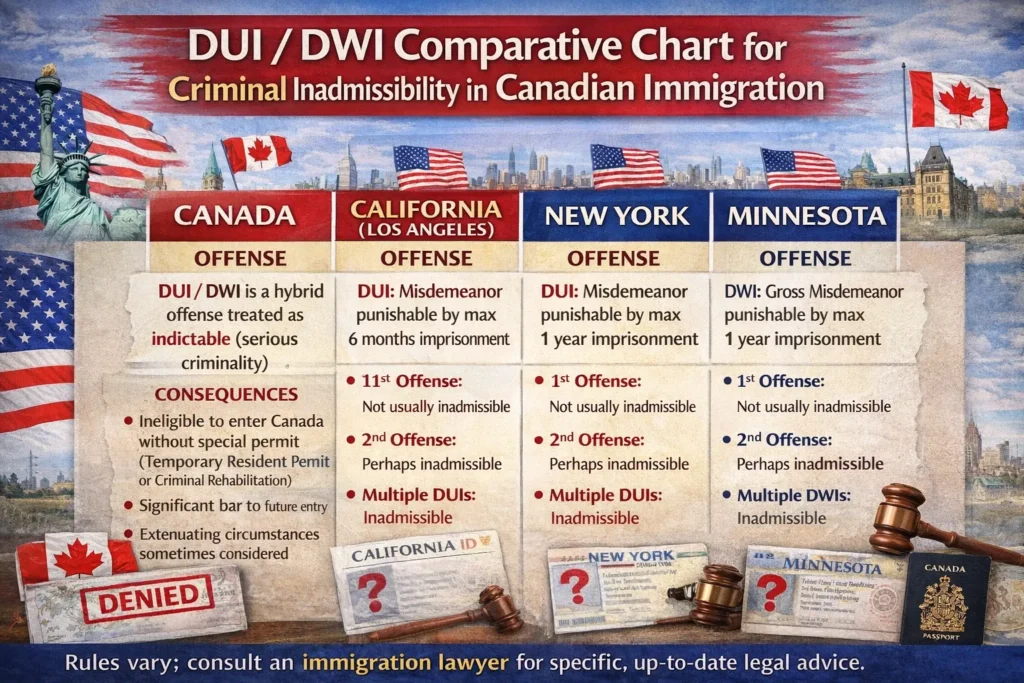
Canadian
border/immigration officers assess U.S. DUI/DWI history through criminal
equivalency—they match the essential elements of the U.S. offence to
the closest Canadian offence (often Criminal Code s. 320.14), then apply IRPA s. 36.
What gets
compared (the “essential elements”)
● Actus reus: driving/operating/being in care or control (what you did)
● Mens rea / standard: “impaired/under the influence/intoxicated” and/or per
se BAC (what must be proven)
1) Core
DUI/DWI laws (motor vehicles)
Jurisdiction | Main
DUI/DWI provision | What it
covers | Per se BAC
(adult) | Notable
wording for equivalency |
Canada
(Federal) | Criminal
Code s. 320.14 | Operating a “conveyance” while impaired / per se within set timeframe | 0.08 (80 mg/100 mL) | “Operate” +
per se concepts; used for U.S. equivalency comparisons |
California
(Los Angeles) | Vehicle
Code s. 23152 | “Drive a
vehicle” while under the influence; includes per se BAC | 0.08 | Includes a
rebuttable presumption tied to testing within a set window |
New York | VTL s. 1192 | “Operate a
motor vehicle” while impaired/intoxicated; includes per se | 0.08 (per se subdivision) | Uses “operate”
(often broader than “drive”) |
Minnesota | Minn. Stat.
s. 169A.20 | Drive/operate/be
in physical control of a motor vehicle; includes per se within 2 hours | 0.08 | Explicit
“physical control”; per se measured within 2 hours |
2) “Bike
DUI” — yes, it can exist (California example)
In some places,
being impaired on a bicycle can still lead to a charge—even if it’s not
prosecuted under the standard motor-vehicle DUI law.
Jurisdiction | Bicycle-specific
impairment rule | Key point |
California
(Los Angeles) | Vehicle
Code s. 21200.5 | Makes it
unlawful to ride a bicycle on a highway while under the influence |
Minnesota | DWI law is
tied to “motor vehicle” | Minnesota
defines “motor vehicle” in a way that excludes human-powered vehicles,
so a standard bicycle typically falls outside the DWI statute |
New York | Core DWI law
is for “motor vehicle” | The main DWI
statute is framed around operating a motor vehicle |
Why this
matters for Canada: If the
U.S. charge is a motor vehicle DUI/DWI, it often maps to Canada’s Criminal
Code s. 320.14. If it’s a bicycle-specific impairment offence (like
California VC 21200.5), the Canadian equivalency analysis may be
different—because Canada’s impaired-operation offences focus on “conveyances”
(not ordinary bicycles), and officers still need a defensible Canadian match
under the equivalency test.
Call A&M
Canadian Immigration Law Corporation: (204) 442-2786
For NY, Minnesota, or California
(Los Angeles) DUI/DWI issues—including bicycle-related charges—a document-based equivalency review can clarify the closest Canadian match and how IRPA
s. 36 may apply.
Disclaimer
(Educational Use Only)
This content is
for general educational and informational purposes only and is not legal
advice. Immigration laws, regulations, policies, and officer practices can
change, and outcomes depend on the facts and official records in each case.
Sources
● IRPA s.
36 (Criminal inadmissibility)
● Canada
Criminal Code s. 320.14 (Operation while impaired)
● Canada
Criminal Code s. 320.19 (Punishment; includes 10-year max on indictment)
● California
Vehicle Code s. 23152 (DUI)
● California
Vehicle Code s. 21200.5 (Bicycle under the influence)
● New York VTL s. 1192
(DWI/DWAI)
● Minnesota Stat. s.
169A.20 (Driving while impaired)
● Minnesota Stat. s.
169A.03 subd. 15 (Motor vehicle definition; excludes human-powered)
Written by:
Dr. Muhammad Abrar (Barrister and Solicitor)
Author | Writer | Mentor | Legal Researcher | Canadian Immigration Case Law and Statistics Analyst