The
Federal Court has confirmed that a permanent resident who misrepresents
information on a Permanent Resident Card (PRC) renewal application cannot
escape the consequences simply because that application was later abandoned.
The decision reinforces the broad reach of the misrepresentation provisions
under the Immigration and Refugee Protection Act (IRPA) and the
principle that accuracy in immigration applications is non-negotiable.
Background
The
Applicant became a permanent resident in 1997. To keep that status, she had to
be physically present in Canada for at least 730 days in every five-year
period. In her 2008 PRC renewal application, she declared 889 days of absence,
but when officers asked her to verify her residency through a questionnaire,
she did not respond, and the application was abandoned. A later investigation
into an immigration consultant’s office uncovered documents showing she had
actually been outside Canada for 1,641 days. When she applied for a new PR card
in 2015, officers reopened the file and issued an inadmissibility report for
misrepresentation, which a Minister’s delegate referred for an admissibility
hearing.
Before
the Federal Court, the Applicant argued that because her 2008 application had
been abandoned, the residency rules no longer applied and the misrepresentation
was irrelevant. She also argued that a misrepresentation in an abandoned
application could not have caused any error in immigration decision-making, and
that the government should be barred from acting against her now because she
had already received a new PR card in 2015.
Court
Findings
The
Court rejected all of these arguments.
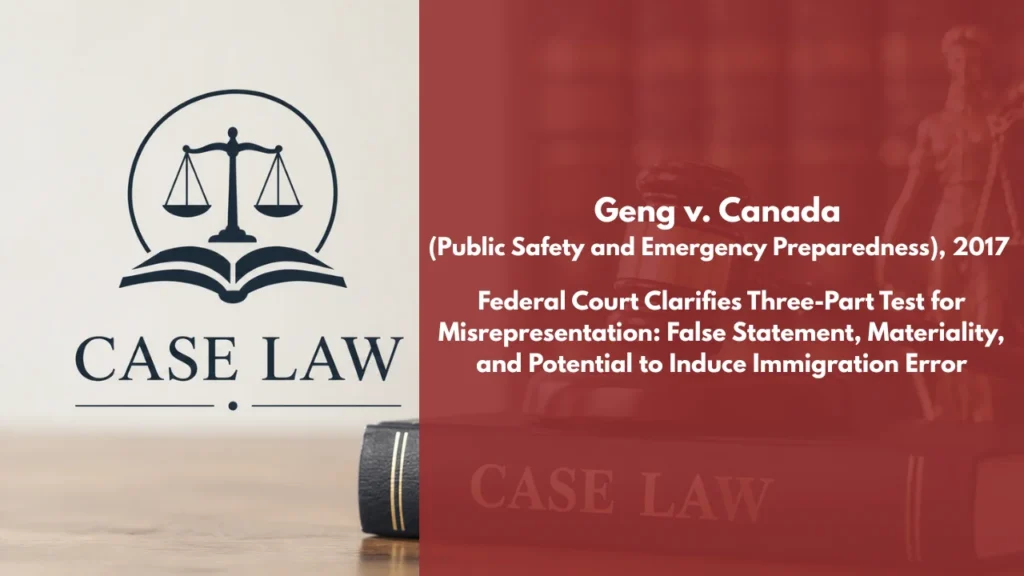
The Federal Court began by setting out the three-part
test for misrepresentation under s.
40(1)(a) of the IRPA: (1) there must be a misrepresentation by the
applicant; (2) it must concern a material fact relating to a relevant
matter; and (3) it must induce, or be capable of inducing, an error in
the administration of the IRPA. Applying that framework, the Court rejected
each of the Applicant’s arguments.
First, the Court held that once a PR card application
is filed, officers are authorized to examine whether the applicant met the
residency requirement—even if the application is later abandoned. The
misrepresentation was therefore relevant to assessing her PR status.
Second, the Court confirmed that misrepresentation is
assessed as of the date it was made, not by reference to what happens to the
application afterward. The mere possibility of an error in the administration
of the IRPA is sufficient. Permitting applicants to escape consequences by
abandoning and resubmitting applications would defeat the purpose of s.
40(1)(a).
Third, the issuance of a new PR card in 2015 did not
bar the government from acting. Estoppel cannot override a statute, and there
was no evidence the government had represented to the Applicant that the
misrepresentation rules would not apply to her.
The Court also found the officer’s reasons adequate
and declined to certify any questions for appeal.
Prepared by:
Dr. Muhammad Abrar (Barrister and Solicitor)
Author | Writer | Mentor | Legal Researcher | Canadian Immigration Case Law and Statistics Analyst