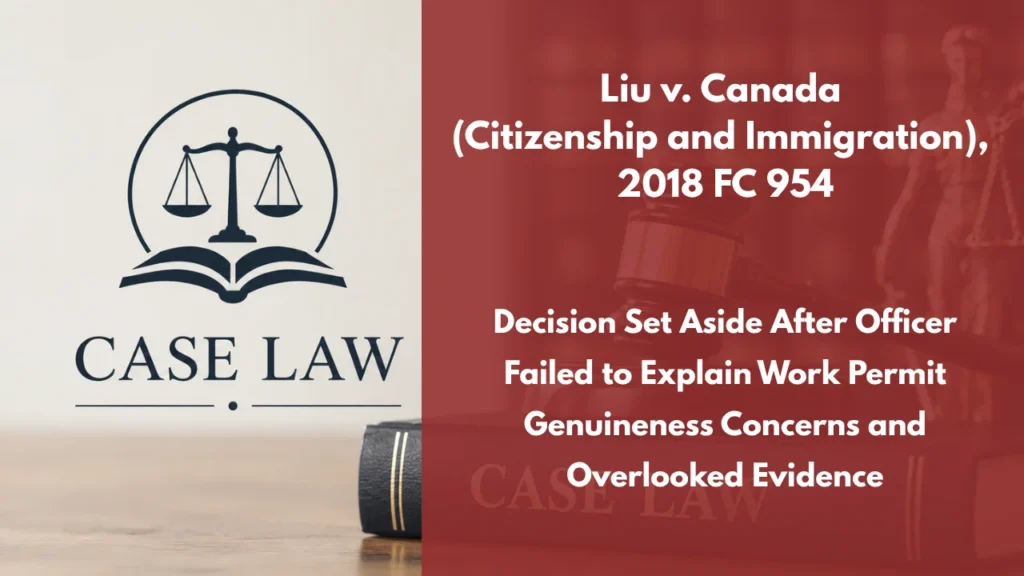
Chunying Liu sought judicial
review of the refusal of her work permit application for employment as an
in-home caregiver in British Columbia. The officer was not satisfied that the
job offer was genuine or that Liu was a bona fide worker who would leave Canada
at the end of her authorized stay. The Federal Court found the decision
unreasonable because the officer merely listed concerns without explaining
their significance and overlooked material evidence addressing those concerns.
Key Principle
A visa officer may provide brief
reasons, but the reasons must still reveal why the evidence led to the refusal.
Listing potentially negative factors without explaining the inferences drawn
from them does not provide the transparency and intelligibility required on
reasonableness review. An officer must also meaningfully consider material
evidence that directly answers concerns about an applicant’s qualifications,
employment history or proposed work.
Background
Liu, a Chinese citizen, had
worked in senior human resources and property-related positions. Her daughter
began studying in Vancouver in 2015 and lived with a homestay family. After
visiting Canada, Liu decided to pursue childcare work. She completed a six-month
in-home caregiver program, including practical training, and worked as a
teaching supervisor.
Her daughter’s homestay parents
offered Liu a two-year caregiver position for their school-aged son. Service
Canada issued a positive LMIA. Liu’s first work permit refusal was set aside by
consent. On redetermination, however, the officer again refused the
application, citing the connection between Liu’s daughter and the employers,
her lack of previous nanny experience, the timing of her caregiver studies, and
the apparent overlap between her employment and training.
Court Findings
• Reasons Did Not Explain Why
the Job Offer Was Not Genuine
The Court found that the GCMS
notes largely listed facts without explaining whether they were negative,
neutral or how they supported the conclusion. Although visa officers need not
provide lengthy reasons, the Court must be able to understand the reasoning
connecting the evidence to the refusal. The officer failed to explain why the
identified circumstances established that the job offer was not genuine.
• Officer Improperly Focused
on Lack of Nanny Experience
The officer emphasized that Liu
lacked previous nanny experience even though the NOC and LMIA did not require
it. The Court found that importing an additional experience requirement without
explanation was problematic. Liu had completed caregiver courses and practicums
and worked supervising children. These qualifications were relevant to her
ability to care for the employers’ child and could not simply be discounted.
• Material Evidence Addressing
Officer’s Concerns Was Overlooked
The officer questioned how Liu
could simultaneously work as a teaching supervisor and complete caregiver
training. However, evidence explained that she worked evenings and weekends
during the training period before later moving into full-time employment. The
record also addressed the proposed caregiver schedule. The Court found that
overlooking evidence directly responsive to material concerns contributed to
the decision’s unreasonableness.
Outcome
The Federal Court granted
judicial review, set aside the refusal and returned the work permit application
for reconsideration by a different officer. No question of general importance
was certified.
Case
Citation:
Liu v. Canada (Citizenship and Immigration), 2018 FC 954 (CanLII)
Prepared by:
Dr. Muhammad
Abrar (Barrister and
Solicitor)
Author | Writer | Mentor | Legal Researcher | Canadian
Immigration Case Law and Statistics Analyst