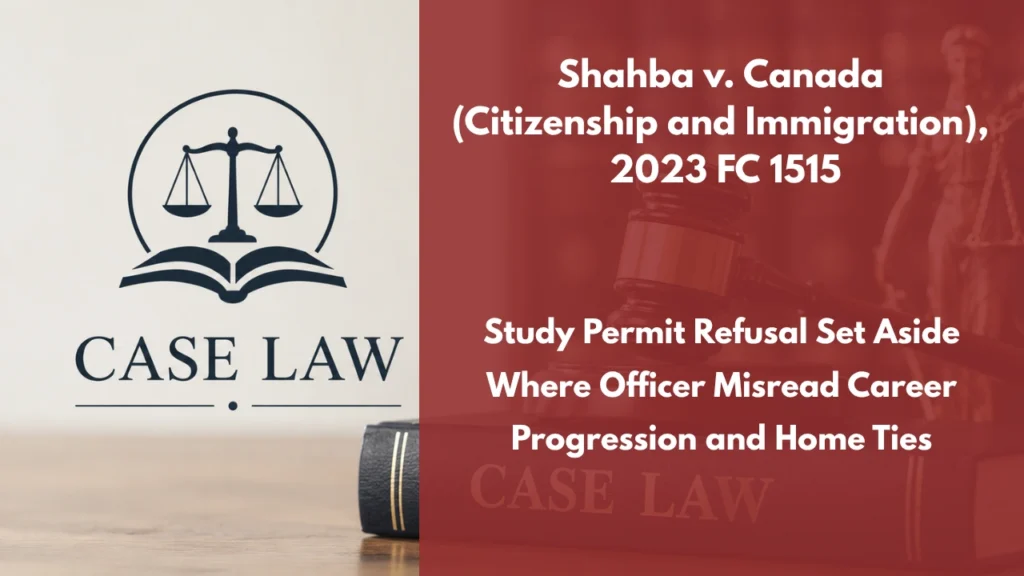
The Federal Court reviewed
Fatemeh Shahba’s study permit refusal for an MA in Leadership at Trinity
Western University. The officer found the program redundant, doubted its career
benefit, and considered her family’s planned travel to Canada as weakening her
ties to Iran. The Court found the reasons did not meaningfully respond to the
evidence.
Key Principle
A study permit refusal must be
justified in light of the actual record. Where an applicant provides specific
evidence of academic progression, career advancement, home-country obligations,
and travel history, an officer cannot simply label the program redundant or the
home ties insufficient without explaining why that evidence fails to establish
temporary intent.
Background
The applicant was a 36-year-old
marketing manager with a bachelor’s degree in Tourism Management. She sought an
MA in Leadership. Her application linked the program to her career, included
employer support for a more senior position on return, and documented ties to
Iran.
Court Findings
• Career Progression Finding
Was Unexplained
The officer described the MA as
redundant and not a logical career progression. The record showed the applicant
had worked in her field since completing her undergraduate degree and that her
employer linked leadership and management studies to a more senior role. The
reasons did not explain why this progression was illogical.
• Program Benefits Were Not
Meaningfully Assessed
The applicant explained why
leadership studies would complement her tourism-management education and
marketing experience. The officer nevertheless stated that she had not shown
compelling benefits from the international program. The Court found the reasons
did not engage with her explanation or show why it was insufficient.
• Home-Country Ties Were
Mischaracterized
The officer relied heavily on the
fact that the applicant intended to travel with her spouse and children,
reasoning this weakened her incentives to return. Yet the application
identified employment prospects, family ties, financial obligations, and other
connections to Iran. The Court could not understand the conclusion that her
ties were insufficient without addressing this evidence.
• Travel History Supported
Temporary Intent
The applicant provided evidence
of significant international travel and consistently returning to Iran.
Although an officer need not mention every piece of evidence, this history was
directly relevant to temporary intent. The absence of meaningful engagement
with it reinforced the conclusion that important parts of the record had been
disregarded or misconstrued.
• Respondent Could Not Supply
Missing Reasons
On judicial review, the
Respondent tried to explain why the senior position was not meaningfully
different from her current work and why a two-year absence was not justified.
The Court held these were reasons the officer had not given. A reviewing court may
connect obvious dots, but cannot construct a new rationale after the fact.
• Reasons Lacked Justification and Transparency
Reading the GCMS notes with the
application, the Court could not discern why the program was considered
redundant or why the applicant’s Iranian ties were insufficient. The decision
did not show a rational path from the evidence to the refusal, rendering it
unreasonable.
Outcome
The Federal Court granted
judicial review, set aside the study permit refusal, and remitted the
application to a different decision-maker for redetermination. No question of
general importance was certified.
Case
Citation:
Shahba v. Canada (Citizenship and Immigration), 2023 FC 1515 (CanLII)
Prepared by:
Dr. Muhammad Abrar (Barrister and Solicitor)
Author | Writer | Mentor | Legal Researcher | Canadian Immigration Case Law and Statistics Analyst