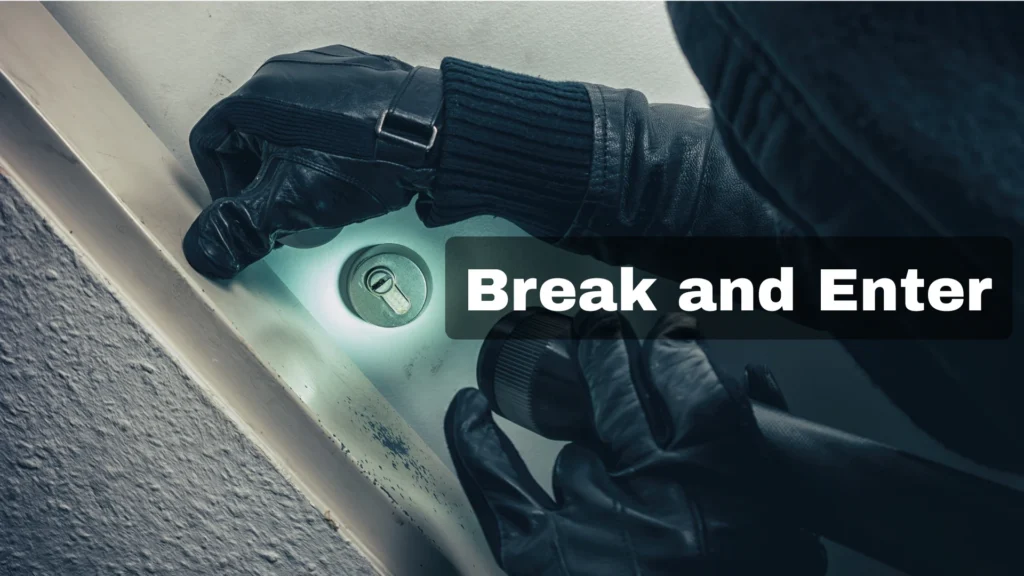
If you have a
U.S. conviction for burglary / break-in conduct and you plan to visit Canada,
apply for a study permit, work permit, or immigrate,
Canadian officers may assess you for criminal inadmissibility under IRPA
s. 36 after completing a criminal equivalency analysis (matching
your U.S. offence to the closest Canadian offence).
1) Canada’s
baseline: Criminal Code s. 348 (Break and Enter)
Canada’s main
“break and enter” offence is Criminal Code s. 348(1), which covers:
● breaking and entering a place with intent to
commit an indictable offence, or
● breaking and entering and committing an indictable
offence, or
● breaking out after committing (or entering with intent to commit)
an indictable offence.
Canadian
punishment (dwelling vs non-dwelling)
● Dwelling-house: indictable, life imprisonment maximum.
● Place other than a dwelling-house: indictable, up to 10 years, or it may be prosecuted as an offence punishable on summary conviction.
Why this
matters for criminal inadmissibility
Once a U.S.
offence is found equivalent to a Canadian offence with a 10+ year maximum (or life), it commonly triggers a serious criminality analysis
under IRPA s. 36(1) for foreign convictions.
2) U.S. → Canada equivalency: what “burglary” usually matches to in Canada
A big reason
equivalency gets tricky is that many U.S. statutes are framed as “entering” with intent to commit a crime (often called “burglary”), while Canada’s s. 348
focuses on “break and enter” (and breaking out) tied to intent to commit
an indictable offence.
3)
Comparison chart: California, New York, Minnesota vs Canada (high-level)
Jurisdiction | Common
offence label | Core
elements (simplified) | Likely
Canadian equivalent(s) |
Canada | Break and
enter (s. 348) | Break + enter
+ intent to commit indictable offence (or commit it / break out) | Criminal
Code s. 348 |
California | Burglary (PC §
459) | Entry into
listed places with intent to commit grand/petit larceny or any felony | Often assessed
against s. 348 (if “break” equivalent exists in facts/record) or other
Canadian property offences depending on record |
New York | Burglary (PL §
140.20 / 140.25 / 140.30) | Enter/remain
unlawfully in a building/dwelling with intent to commit a crime; higher
degrees add weapons/injury/dwelling factors | Often s.
348 (dwelling vs non-dwelling analysis can matter) |
Minnesota | Burglary
(Stat. § 609.582) | Enter a
building without consent with intent to commit a crime; degrees depend on
dwelling, people present, weapons/assault, etc. | Often s.
348 (dwelling vs non-dwelling) and/or related offences based on facts |
4) Why
“dwelling” matters (it can change the seriousness)
In Canada,
break and enter into a dwelling-house carries a life maximum,
which is a major seriousness indicator for inadmissibility analysis.
This is why an American “residential
burglary” record often draws closer scrutiny than a commercial break-in, even
before you get to the details of equivalency.
Call A&M
Canadian Immigration Law Corporation: (204) 442-2786
If you need to visit, study,
work, or immigrate to Canada and you have a burglary/break-in record from
California, New York, or Minnesota, a document-based equivalency review can
identify the closest Canadian match (often Criminal Code s. 348) and how IRPA s. 36 may apply.
Disclaimer
(Educational Use Only)
This content is
for general educational and informational purposes only and is not legal
advice. Immigration laws, regulations, and officer practices can change. U.S.
burglary laws vary by state and may change over time, and outcomes depend
on the exact statute section, offence date, and official court records.
Sources
(hyperlinks)
● Canada — Criminal
Code s. 348 (break and enter; dwelling = life;
other place = up to 10 years or summary)
● Canada — IRPA
s. 36 (criminal inadmissibility framework)
● California — Penal
Code § 459 (burglary)
● New York — Penal Law
§ 140.20 (burglary 3rd)
● New York — Penal Law § 140.25 (burglary 2nd)
● New York — Penal Law § 140.30 (burglary 1st)
● Minnesota — Stat. § 609.582 (burglary)
Written by:
Dr. Muhammad Abrar (Barrister and Solicitor)
Author | Writer | Mentor | Legal Researcher | Canadian Immigration Case Law and Statistics Analyst
Frequently Asked Questions
Yes. If your U.S. burglary matches Canada’s break and enter (especially involving a dwelling-house), officers may assess criminal inadmissibility under IRPA s. 36.
It can. Equivalency depends on the statute, what was proven/admitted, and whether the Canadian equivalent would still be an offence (often the record details are critical).
Not automatically. Some U.S. burglary laws are based on “entry” with intent (even without a physical “break”), which can make the Canadian match more complex and record-driven.