The
Federal Court upheld IRCC’s refusal of an open work permit application and
confirmed a finding of misrepresentation under section 40(1)(a) of the
Immigration and Refugee Protection Act (IRPA) where the applicant relied on
educational credentials that were found not to have been legitimately earned.
The Court dismissed the judicial review and reaffirmed that applicants bear
responsibility for proving the legitimacy of educational credentials submitted
in support of immigration applications.
Background
Mr.
Yip applied for an open work permit under the Hong Kong Special Measures
Category, which required applicants to have graduated with an eligible
educational credential within a prescribed period. To satisfy this requirement,
Mr. Yip relied on an MBA from the University of Chichester (UK) and an OTHM
Level 7 Diploma, which served as the prerequisite qualification for
admission into the MBA program. He also submitted a World Education Services
(WES) assessment recognizing the MBA as equivalent to a Canadian master’s
degree.
During
processing, IRCC raised concerns about educational fraud involving accelerated
degree pathways and invited Mr. Yip to attend an interview and provide detailed
supporting records, including coursework, transcripts, and proof of exemptions
from prerequisite coursework. At the interview, IRCC questioned how Mr. Yip
completed the qualifications in a shortened period and whether he had actually
completed the required studies.
The
Officer identified several concerns. Mr. Yip could not provide proof explaining
exemptions for a substantial portion of the required coursework. He admitted
relying on an education agent and stated that he simply followed instructions
without questioning how exemptions had been granted. The Officer also noted
inconsistencies in his resumes, which appeared to show that he had obtained the
MBA before beginning prerequisite studies. Additional concerns arose from Mr.
Yip’s inability to explain research methods, assignments, copied content, and
basic elements of his claimed studies.
Based
on the interview and documents, IRCC concluded that Mr. Yip had not
demonstrated that the credentials were legitimately earned and found
that he had misrepresented a material fact capable of inducing an error in
immigration administration. This resulted in refusal of the work permit and a five-year
inadmissibility period under section 40 of IRPA.
Before
the Federal Court, Mr. Yip argued that there was insufficient evidence of
fraud, that he had relied in good faith on the education agent, and that any
issue amounted to innocent mistake. He also alleged procedural unfairness and
argued that IRCC improperly relied on external information.
Court
Findings
The
Court rejected each of Mr. Yip’s arguments and dismissed the judicial review.
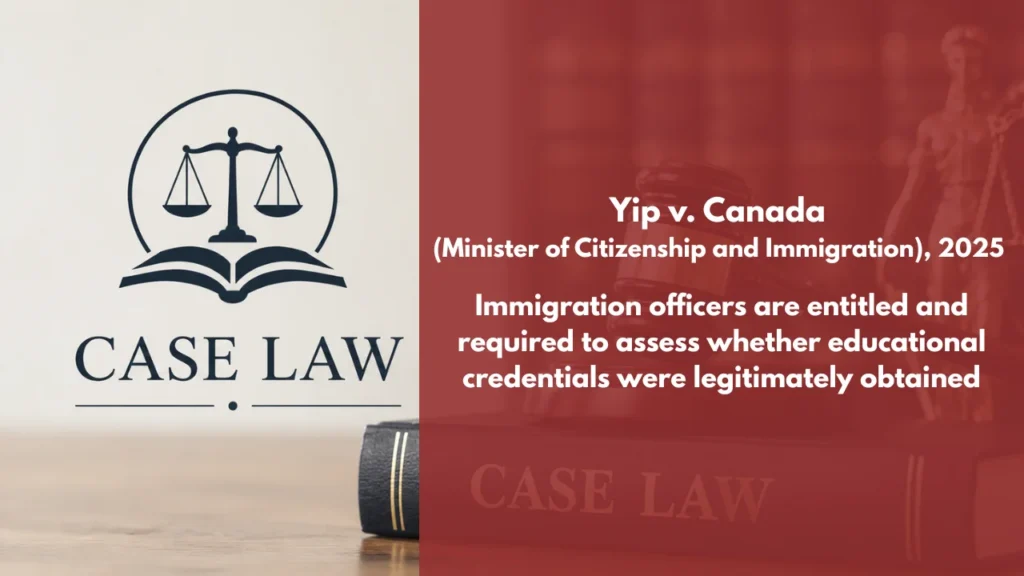
Immigration officers are entitled—and indeed required—to assess whether
educational credentials were legitimately obtained, not merely
whether the diplomas or transcripts appear authentic on their face. Section 40
must be interpreted broadly to protect the integrity of the immigration system,
and applicants remain responsible for information submitted on their behalf,
whether directly or through a third party such as an education agent.
The
Court emphasized that section 40 is interpreted broadly to protect the
integrity of the immigration system and that applicants remain responsible for
information submitted directly or through third parties. The Court also held
that the innocent misrepresentation exception is narrow, requiring both
an honest and objectively reasonable belief, which Mr. Yip failed to establish.
Finally, the Court found no breach of procedural fairness. The interview itself had given Mr. Yip a meaningful opportunity to respond to the Officer’s concerns about how the credentials had been earned.
Prepared by:
Dr. Muhammad Abrar (Barrister and Solicitor)
Author | Writer | Mentor | Legal Researcher | Canadian Immigration Case Law and Statistics Analyst