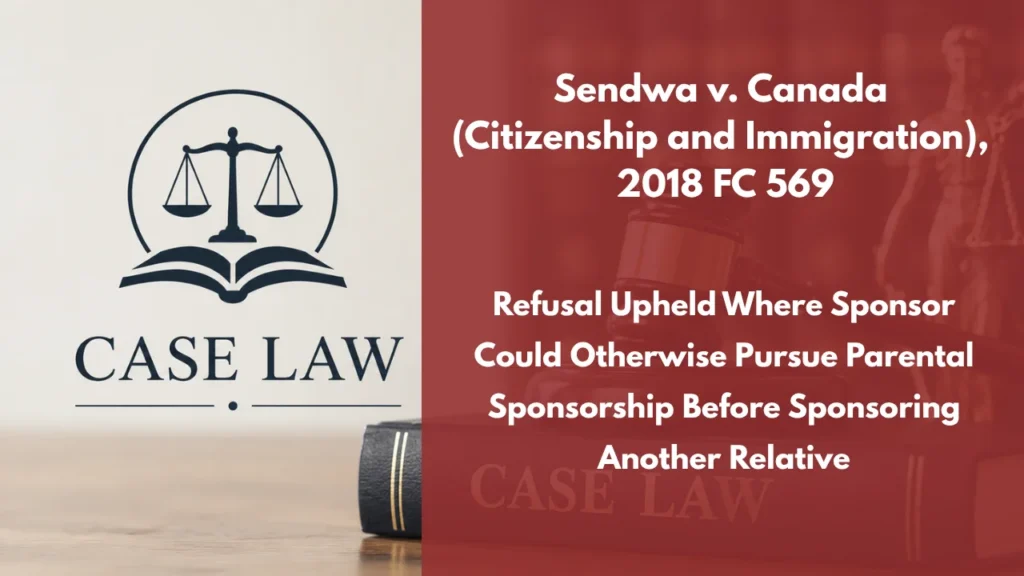
The Federal Court reviewed the
Immigration Appeal Division’s second decision dismissing Thecla Sendwa’s appeal
from the refusal of her application to sponsor her adult niece from Tanzania
under paragraph 117(1)(h) of the IRPR. Although Ms. Sendwa lacked the income
ordinarily required to sponsor her parents, the IAD concluded that the
statutory appeal process could potentially overcome financial or medical
barriers to parental sponsorship. The Court upheld the IAD’s interpretation and
dismissed the judicial review.
Key Principle
Paragraph 117(1)(h) of the IRPR
operates as a mechanism of last resort for sponsoring another relative. A
sponsor cannot use this provision merely because an enumerated relative, such
as a parent, may initially face financial or admissibility barriers. If the
sponsor may otherwise sponsor an enumerated relative, including through
available statutory appeal and H&C mechanisms capable of overcoming an
initial refusal, the condition for sponsoring a generic relative under
paragraph 117(1)(h) is not met.
Background
Ms. Sendwa, a Canadian citizen
with no relatives in Canada, sought to sponsor her adult niece. Her parents
remained alive. A first IAD panel dismissed her appeal because her parents
could be sponsored regardless of their possible inadmissibility. In Sendwa 1,
the Federal Court set that decision aside, holding that paragraph 117(1)(h)
must be considered from the sponsor’s perspective and that the IAD had failed
to examine whether Ms. Sendwa was actually eligible or in a position to sponsor
her parents.
On redetermination, the IAD
accepted that Ms. Sendwa likely lacked the required income to sponsor her
parents. However, it reasoned that a parental sponsorship refusal could be
appealed to the IAD, where H&C relief might overcome financial ineligibility
or medical inadmissibility. The IAD therefore again dismissed her appeal.
Court Findings
• Paragraph 117(1)(h) Is a
Last-Resort Provision
The Court rejected Ms. Sendwa’s
argument that, once no enumerated relative was already in Canada and she was
financially ineligible to sponsor her parents, she could freely sponsor another
relative. Reading section 117 as a whole, the Court held that a generic
relative can be sponsored only when there is no enumerated relative whom the
sponsor may otherwise sponsor.
• IAD Complied With the
Earlier Federal Court Decision
Sendwa 1 did not expressly
order the IAD to treat financial ineligibility as determinative. The
redetermination properly considered whether Ms. Sendwa was eligible or
otherwise in a position to sponsor her parents. The Court therefore rejected
the argument that the IAD disregarded stare decisis or failed to follow
the earlier judgment.
• Appeal Rights Could Affect
Sponsorship Capacity
Although an appeal under
subsection 63(1) of the IRPA is a right rather than an obligation, its
availability provided another means by which an initial parental sponsorship
refusal might be overcome. The Court found it reasonable for the IAD to include
that possibility when determining whether Ms. Sendwa might otherwise sponsor
her parents. The Court also rejected the allegation of bias as speculative and
unsupported.
Outcome
The Federal Court dismissed
judicial review, finding the IAD’s interpretation and application of paragraph
117(1)(h) reasonable. The Court permitted the parties to make later submissions
on a possible certified question.
Case
Citation:
Sendwa v. Canada (Citizenship and Immigration), 2018 FC 569 (CanLII)
Prepared by:
Dr. Muhammad Abrar (Barrister and Solicitor)
Author | Writer | Mentor | Legal Researcher | Canadian Immigration Case Law and Statistics Analyst