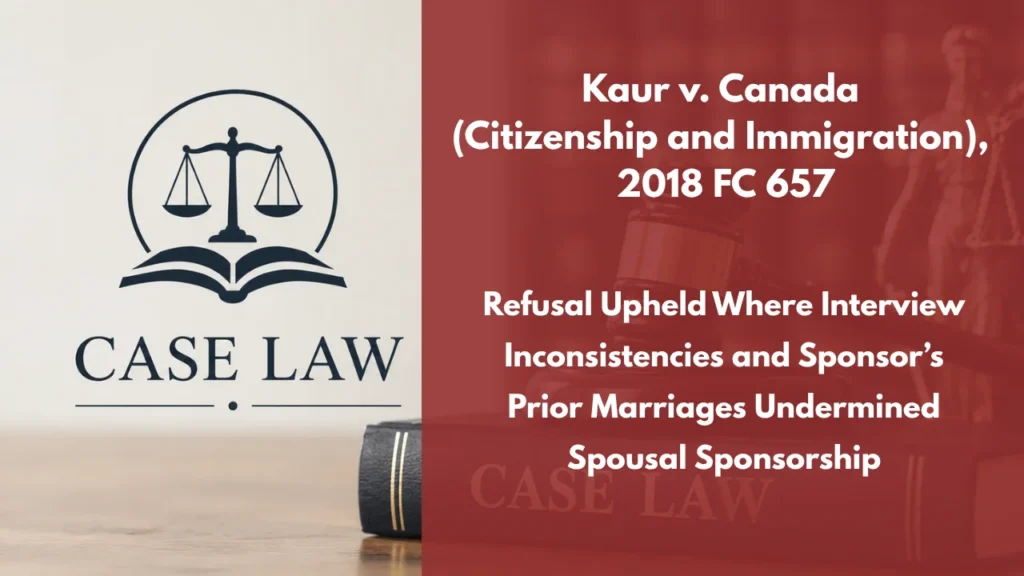
The Federal Court reviewed the
refusal of Gurpreet Kaur’s inland spousal permanent residence application. The
officer concluded that Ms. Kaur had not established that her marriage to
Canadian citizen Surjeet Singh Nahal was genuine and was not entered into
primarily for immigration purposes under subsection 4(1) of the IRPR. The Court
upheld the decision, finding that the officer reasonably considered
inconsistencies from the couple’s interviews, the sponsor’s extensive marital
and sponsorship history, and their demeanour.
Key Principle
An officer assessing a marriage
under subsection 4(1) of the IRPR may consider the sponsor’s previous
marriages, prior spousal sponsorship applications, the circumstances in which
those marriages ended, discrepancies between the spouses’ interview answers,
and their demeanor. The birth of a child is relevant evidence but does not, by
itself, establish that a marriage was genuine when entered into. Judicial
review is not an opportunity to provide new explanations for inconsistencies or
ask the Court to reweigh the evidence.
Background
Ms. Kaur, an Indian citizen,
entered Canada as a temporary foreign worker in 2013. Mr. Nahal, a Canadian
citizen, had previously married four Indian nationals and had sponsored or
attempted to sponsor each of them. One previous sponsorship had been refused
because of marriage-of-convenience concerns.
Ms. Kaur had known Mr. Nahal
since 2008 and first met him personally in 2012 while he was still married to
his fourth wife. They began cohabiting in January 2014, married in May 2015
after his divorce, and applied for permanent residence the following month.
Their daughter was born in November 2016.
At a March 2017 interview, the
officer identified numerous discrepancies concerning when the couple met and
began cohabiting, their honeymoon and recent vacation, their most recent
intimacy, their knowledge of each other’s origins, the sponsor’s work schedule,
and their weekend activities.
Court Findings
• Previous Marriages and
Sponsorships Were Relevant
The Court held that previous
marriages are legitimate considerations when assessing genuineness. It added
that officers may reasonably consider the number and nature of previous spousal
sponsorship applications and when and why those marriages ended. The officer
did not treat Mr. Nahal’s history as determinative but considered it alongside
the remaining evidence.
• Interview Inconsistencies
and Demeanour Supported the Decision
Ms. Kaur attempted to explain
several discrepancies during judicial review, including her uncertainty about
the honeymoon destination. The Court found that these submissions effectively
sought to modify the record and have the evidence reweighed. The officer was
entitled to consider the inconsistencies and the couple’s body language during
the interview.
• Child Did Not Automatically
Establish a Genuine Marriage
The Court rejected the argument
that the officer improperly discounted the couple’s child. Read in context, the
officer’s comments reflected the established principle that having a child does
not independently prove the bona fides of a marriage at the time it was entered
into. All circumstances had to be considered together. The Court also rejected
allegations of bad faith, finding no evidence that the officer had
predetermined the application.
Outcome
The Federal Court dismissed
judicial review. The officer’s assessment of the marriage was reasonable, and
the allegations of bad faith were unsupported. No question of general
importance was certified.
Case
Citation:
Kaur v. Canada (Citizenship and Immigration), 2018 FC 657 (CanLII)
Prepared by:
Dr. Muhammad Abrar (Barrister and Solicitor)
Author | Writer | Mentor | Legal Researcher | Canadian Immigration Case Law and Statistics Analyst