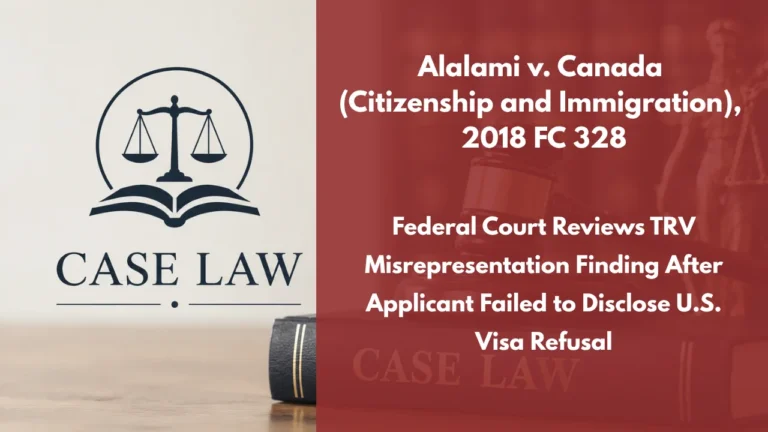
The Federal Court reviewed the
refusal of Walid Alalami’s temporary resident visa application and the
accompanying five-year inadmissibility finding for misrepresentation under
paragraph 40(1)(a) of the IRPA. Mr. Alalami failed to disclose a 2015 U.S. visa
refusal and later explained that he had misunderstood the application question
as referring only to Canadian refusals. The Court upheld the decision, finding
that the procedural fairness letter adequately identified the concern, the
officer reasonably rejected the innocent-error explanation, and the undisclosed
refusal remained material even though Canadian authorities discovered it
independently.
Key Principle
An applicant’s failure to
disclose a material immigration fact does not become immaterial merely because
Canadian immigration authorities can discover the correct information through
information sharing or other sources. What matters under paragraph 40(1)(a) is
whether the misrepresentation induced or could have induced an error in
administering the IRPA. Where an officer reasonably concludes that an omission
was intentional, the narrow innocent-error exception does not apply.
Background
Mr. Alalami, a Jordanian citizen
living in Ghana, had worked for the same company since 2004 and travelled
extensively internationally. In January 2017, he applied for a Canadian TRV to
meet a client and attend a trade exposition.
On his application, he answered
that he had never been refused a visa or admission by Canada or another
country. Canadian records showed a 2015 U.S. visa refusal. IRCC sent him a
procedural fairness letter identifying the discrepancy and warning that it could
result in a misrepresentation finding.
Mr. Alalami responded that he had
misread the question and believed it concerned only Canadian refusals. The
officer rejected that explanation, found that he had withheld material
information, questioned the true purpose of his Canadian visit, refused the
TRV, and imposed the five-year inadmissibility consequence.
Court Findings
• Procedural Fairness Letter
Provided Adequate Notice
The Court rejected the argument
that the officer was required to provide another opportunity to respond after
deciding not to believe Mr. Alalami’s explanation. The PFL clearly identified
the undisclosed U.S. refusal and possible misrepresentation finding. Procedural
fairness did not require the officer to advise him that his explanation would
be rejected before making the decision.
• Innocent-Error Exception Did
Not Apply
The Court accepted that an honest
and reasonable mistake can, in limited circumstances, avoid a misrepresentation
finding. However, the officer did not accept that Mr. Alalami’s omission was
innocent. His employment stability and extensive travel history could support
his explanation, but the officer was not required to expressly discuss every
piece of evidence.
• Independent Discovery Did
Not Defeat Materiality
The Court rejected the argument
that the omission was immaterial because Canadian authorities apparently
learned of the U.S. refusal through information sharing. Materiality does not
depend on whether IRCC actually catches the false statement. The undisclosed
refusal concerned a comparable visa and could affect the officer’s assessment
of the applicant’s credibility, purpose of travel, and intention to leave
Canada.
Outcome
The Federal Court dismissed
judicial review. The officer’s misrepresentation finding and TRV refusal were
reasonable, and the process was procedurally fair. No question was certified.
Case
Citation:
Alalami v. Canada (Citizenship and Immigration), 2018 FC 328 (CanLII)
Prepared by:
Dr. Muhammad Abrar (Barrister and Solicitor)
Author | Writer | Mentor | Legal Researcher | Canadian Immigration Case Law and Statistics Analyst