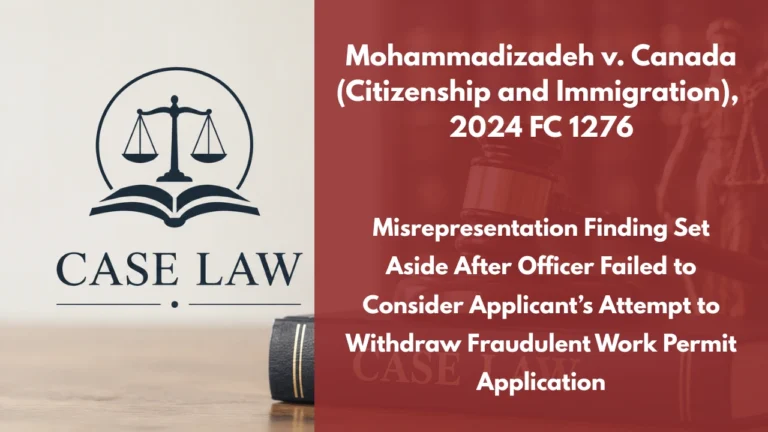
The Federal Court allowed an
application for judicial review of a work permit refusal and the accompanying
finding of inadmissibility for misrepresentation under section 40(1)(a) of the Immigration
and Refugee Protection Act (IRPA). The applicant unknowingly submitted a
fraudulent Labour Market Impact Assessment (LMIA) through an unauthorized
immigration agency in Iran and later attempted to withdraw his application
months before IRCC raised any concerns about misrepresentation. The Court held
that the officer’s failure to meaningfully consider the applicant’s withdrawal
request rendered the decision unreasonable, particularly given the serious
consequences of a five-year inadmissibility finding.
Key Principle
While applicants remain
responsible for the accuracy of information submitted in immigration
applications, visa officers must meaningfully consider evidence relevant to the
innocent misrepresentation exception. Where an applicant attempts to withdraw
an application before receiving notice of a possible misrepresentation, that
conduct may be relevant to assessing due diligence and whether the applicant
honestly and reasonably believed no misrepresentation had occurred. Officers
must address such evidence before imposing the severe consequences associated
with section 40 of the IRPA.
Background
The applicant retained an
immigration agency in Iran to prepare and submit a work permit application.
Several months after filing the application, he became concerned about the
legitimacy of the services he had received and attempted to withdraw the application.
Approximately five months later, IRCC issued a procedural fairness letter
advising that the LMIA supporting the application appeared to be fraudulent. In
response, the applicant explained that he had been defrauded by the immigration
agency, which had allegedly deceived hundreds of other individuals and was the
subject of criminal proceedings and an Interpol Red Notice in Iran. Despite
this evidence, the officer concluded that the applicant remained responsible
for ensuring the authenticity of the documents submitted and found him
inadmissible for misrepresentation.
Court Findings
• A Pre-emptive Withdrawal
Request May Be Relevant to Innocent Misrepresentation
The Court held that the officer
failed to address a critical aspect of the applicant’s case—his attempt to
withdraw the work permit application months before IRCC identified the alleged
misrepresentation. Unlike cases where applicants seek to withdraw applications
only after misrepresentation concerns are raised, the applicant’s withdrawal
request predated the procedural fairness letter and could have been relevant to
assessing whether he exercised due diligence and honestly believed the
application was inaccurate. The absence of any analysis of this issue rendered
the decision unreasonable.
• Incomplete Record Prevented
a Reasonable Assessment
The Court noted that the
Certified Tribunal Record contained only a brief and ambiguous GCMS notation
confirming that the withdrawal request had been received. It was unclear
whether the request had been accepted, refused, or otherwise processed. Given the
lack of information about such a significant issue, the officer could not
reasonably ignore the withdrawal request when determining whether the applicant
had engaged in misrepresentation.
• Existing Jurisprudence on
Withdrawal Did Not Apply
The Minister relied on
authorities holding that applicants cannot avoid a misrepresentation finding by
withdrawing an application after IRCC detects the deception. The Court
distinguished those cases, emphasizing that the applicant attempted to withdraw
his application approximately five months before IRCC issued its procedural
fairness letter. Accordingly, the policy concerns identified in earlier
authorities did not apply to these facts.
Outcome
The Federal Court allowed the
application for judicial review, set aside the finding of inadmissibility for
misrepresentation, and remitted the matter to a different decision-maker for
redetermination. The Court also directed that the applicant be given an
opportunity to provide further evidence and submissions. The decision confirms
that an applicant’s attempt to withdraw an application before any
misrepresentation concerns arise may be a highly relevant consideration in
assessing due diligence and the innocent misrepresentation exception under
section 40 of the IRPA.
Case Citation:
Mohammadizadeh v. Canada (Citizenship and Immigration), 2024 FC 1276 (CanLII)
Prepared by:
Dr. Muhammad Abrar (Barrister and Solicitor)
Author | Writer | Mentor | Legal Researcher | Canadian Immigration Case Law and Statistics Analyst