The Federal
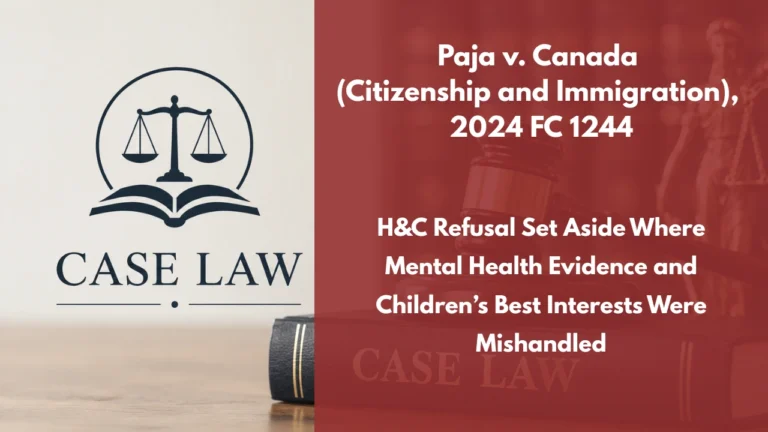
Court reviewed the refusal of Armando Paja and Armela Zenelaj’s H&C
application. The application relied on family establishment, adverse conditions
abroad, Armela’s mental health, and the best interests of their two
Canadian-born children. The Court granted judicial review because the officer
unreasonably discounted the psychological evidence and applied the wrong legal
approach to the children’s interests.
Key
Principle
An H&C
officer must assess psychological evidence according to its stated purpose and
cannot discount a professional report merely because it relies on
self-reporting or does not address matters outside its scope. Once an officer
finds that a particular outcome is probably in a child’s best interests, that
conclusion must receive substantial weight. The assessment must identify the
option that best protects the child’s well-being and development, rather than
asking only whether removal would cause serious hardship.
Background
The
applicants had lived in Canada since 2016 with their two Canadian-born
children. Armela had previously been diagnosed with major depressive disorder
and post-traumatic stress disorder and later received psychotherapy for
continuing anxiety, depression, and trauma-related symptoms.
The officer
gave positive weight to the family’s establishment but found that the mental
health evidence, conditions abroad, and the children’s interests did not
justify relief.
Court
Findings
• Earlier
Psychological Diagnosis Was Treated Unclearly
The officer
accepted that Armela had received a diagnosis in 2016 but questioned the
absence of a later diagnosis or treatment. The reasons did not clearly state
whether the officer accepted that the diagnosed conditions continued, had
diminished, or no longer existed.
Because the
earlier report was central to the mental health claim and supported later
evidence, this ambiguity prevented the Court from understanding what role the
diagnosis played in the final assessment.
•
Self-Reporting Was Not a Valid Basis to Discount the Report
The officer
gave little weight to the later psychotherapy report partly because it relied
on Armela’s self-reported symptoms. The Court held that mental health
professionals commonly rely on patient accounts because they rarely witness the
traumatic events underlying psychological conditions.
Discounting
the report on this basis ignored established jurisprudence and failed to assess
the professional findings on their actual evidentiary value.
• Report
Was Faulted for Addressing the Wrong Question
The officer
also criticized the psychotherapy report for not predicting the effect of
relocation on Armela’s mental health. However, the report’s stated purpose was
to document current symptoms and recommend treatment, not to provide an opinion
about future removal-related harm.
The officer
therefore unreasonably reduced its weight based on information the report was
never intended to provide.
•
Children’s Best Interests Were Given Insufficient Weight
The officer
found that remaining in Canada was probably in the children’s best interests
but assigned that finding limited weight. Once the officer reached that
conclusion, the governing jurisprudence required the children’s interests to be
treated as an important factor and given substantial weight.
• Officer
Applied a Hardship Test Instead of the Proper BIOC Test
The reasons
repeatedly asked whether the children’s well-being would be impaired,
compromised, or harmed by relocation. That approach focused on avoiding
hardship rather than determining which available outcome would best support
their overall development and well-being.
•
Evidence About the Children Required Fuller Consideration
The children
did not speak the language of the destination country, were unfamiliar with its
culture, and had established relationships and schooling in Canada. The officer
accepted some of these facts but did not meaningfully explain how they affected
the comparative assessment of the children’s best interests.
Outcome
The Federal
Court granted judicial review, set aside the H&C refusal, and returned the
application to a different officer for redetermination. No question was
certified.
Case
Citation:
Paja v. Canada (Citizenship and Immigration), 2024 FC 1244 (CanLII)
Prepared by:
Dr. Muhammad Abrar (Barrister and Solicitor)
Author | Writer | Mentor | Legal Researcher | Canadian Immigration Case Law and Statistics Analyst