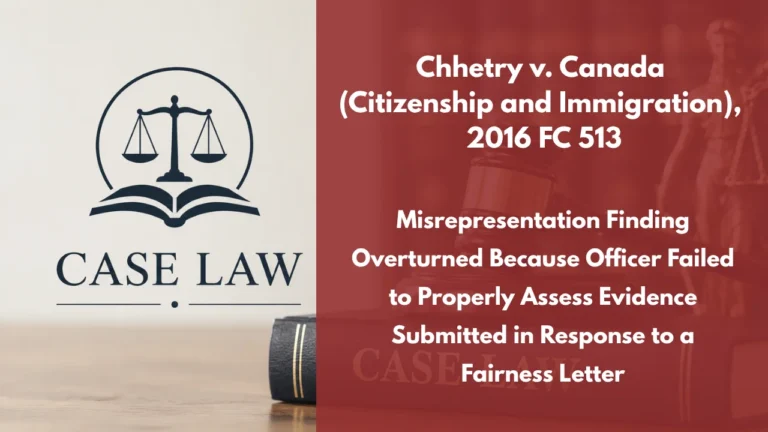
The Federal Court reviewed a permanent residence refusal and
five-year inadmissibility finding for misrepresentation concerning the
applicant’s employment history.
The applicant had been given an opportunity to respond to
concerns about omitted employment information. He provided an explanation and
additional employment documents. The Court found that the officer failed to
reasonably assess this response and the supporting evidence, particularly
evidence that addressed the alleged inconsistencies.
Key Principle
Where an applicant responds to a procedural fairness letter
with explanations and corroborating evidence, the officer must
meaningfully consider that evidence before making a finding of
misrepresentation.
Although applicants have a personal duty to ensure that
their applications are complete and accurate, an officer cannot maintain a
misrepresentation finding by simply stating that the applicant’s response did
not resolve the concerns without addressing significant evidence that directly
responds to those concerns.
A misrepresentation must also be material, meaning it
must be important enough to affect, or potentially affect, the administration
of the IRPA.
Background
The applicant, a citizen of Nepal, applied for permanent
residence as a university professor or lecturer. His application contained
employment information that did not include his employment with Jet Airways and
a cruise line.
After open-source information raised concerns about his
employment history, the officer sent a procedural fairness letter. The
applicant’s consultant responded, explaining that the omissions were
administrative errors and providing updated forms and supporting documents.
The processing officer identified further inconsistencies
concerning the dates of the applicant’s employment. The visa officer ultimately
concluded that the applicant had misrepresented his employment history and that
the misrepresentation could have affected the points awarded in his
application.
Court Findings
The Federal Court found that the officer’s treatment of the
applicant’s response was unreasonable.
The Court noted that the applicant had provided a letter
from the managing director of Jet Airways confirming his employment dates,
along with other documents supporting his employment history. The evidence was
consistent with the corrected employment history, yet the processing officer
appeared either not to have considered the managing director’s letter or failed
to recognize its significance.
The Court also found that the visa officer did not explain
why the additional evidence failed to resolve the concerns raised in the
fairness letter. The officer’s apparent failure to properly consider this
evidence affected the finding that the applicant’s employment history was
unreliable.
The Court further questioned the materiality of the
alleged omission. The evidence suggested that the omitted employment did not
alter the employment experience relied upon for the applicant’s qualifying
points. Therefore, it was unclear how the omission could have affected the
administration of the IRPA.
Outcome
The Federal Court allowed the application for judicial
review, set aside the decision, and returned the matter for
redetermination.
Case Citation:
Chhetry v. Canada (Citizenship and Immigration), 2016 FC 513 CanLII
Prepared by:
Dr. Muhammad
Abrar (Barrister and
Solicitor)
Author | Writer | Mentor | Legal Researcher | Canadian Immigration Case Law and
Statistics Analyst