The
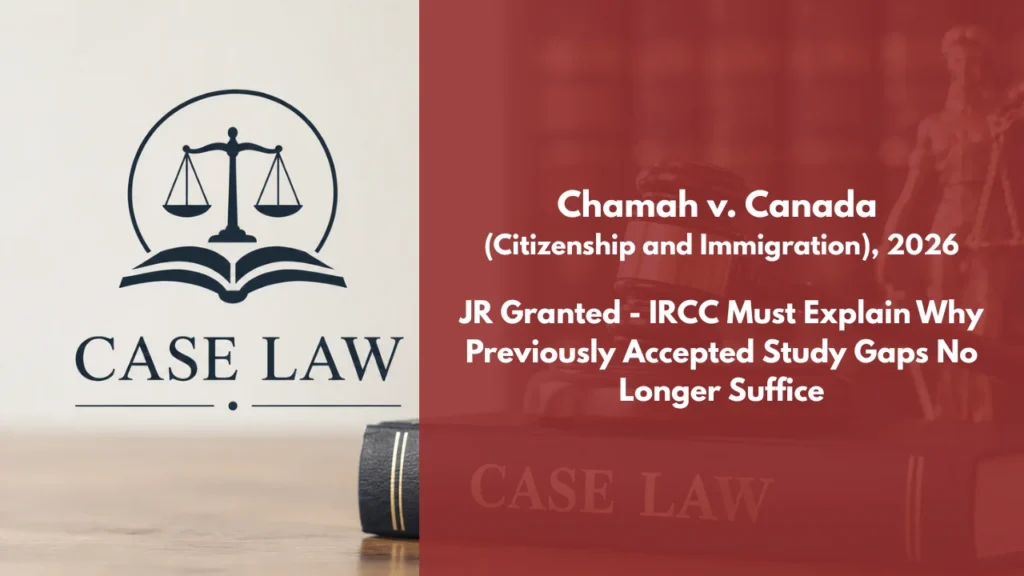
Federal Court reviewed IRCC’s refusal of a study permit restoration
application. The applicant had previously explained a gap in his studies during
the COVID-19 pandemic, and IRCC had accepted those explanations when granting
him a study permit extension. The Court found it unreasonable for a later
officer to reject the restoration application based on the same study gap
without addressing the prior approval or explaining why the earlier assessment
was no longer sufficient.
Key
Principle
The
decision confirms that when IRCC has previously accepted explanations for a
study interruption and granted status on that basis, a subsequent officer must
meaningfully address that prior determination before reaching a contrary
conclusion. Failure to engage with a central submission may render a decision
unreasonable.
Background
Joskey
Otieno Chamah, a citizen of Kenya, had been studying in Canada since 2015 and
attended the University of Manitoba beginning in 2018. During Winter 2020 and
Fall 2020, he experienced an interruption in his studies due to circumstances
related to the COVID-19 pandemic and personal challenges.
When
applying to extend his study permit in 2023, Chamah provided explanations and
supporting documents regarding the study gap. IRCC accepted those explanations
and granted him a study permit extension valid until October 2024.
Before
that permit expired, Chamah applied for another extension. The application was
refused because he failed to include a new explanatory letter regarding the
2020 interruption. After losing status, he applied for restoration within the
prescribed 90-day period, resubmitted the same explanations and documents, and
specifically pointed out that IRCC had already reviewed and accepted those
materials during the earlier extension application.
Court
Findings
Justice
Ngo found the refusal unreasonable. The restoration officer concluded that the
applicant had been out of studies for more than 150 days and therefore had not
complied with subsection 220.1(1) of the Immigration and Refugee Protection
Regulations. However, the officer failed to address a central issue raised by
the applicant: IRCC had already reviewed the same study interruption and
nevertheless approved a study permit extension.
The
Court emphasized that the problem was not the brevity of the reasons but their
complete silence on a key argument. The applicant had identified the earlier
application file number, submitted the previous approval, and resubmitted the
supporting evidence that had already been accepted by IRCC. Despite this, the
officer provided no explanation as to why the earlier assessment was being
disregarded or why the same evidence was now considered insufficient.
The
Court held that where an applicant raises a significant issue directly relevant
to the outcome of the application, the decision-maker must engage with that
issue. The failure to address IRCC’s prior acceptance of the study gap
explanation rendered the decision lacking in justification, transparency, and
intelligibility.
The
Federal Court allowed the judicial review, set aside the restoration refusal,
and returned the matter to a different officer for reconsideration.
Case Citation: Chamah v. Canada (Citizenship and Immigration), 2026 FC 449 (CanLII)