The
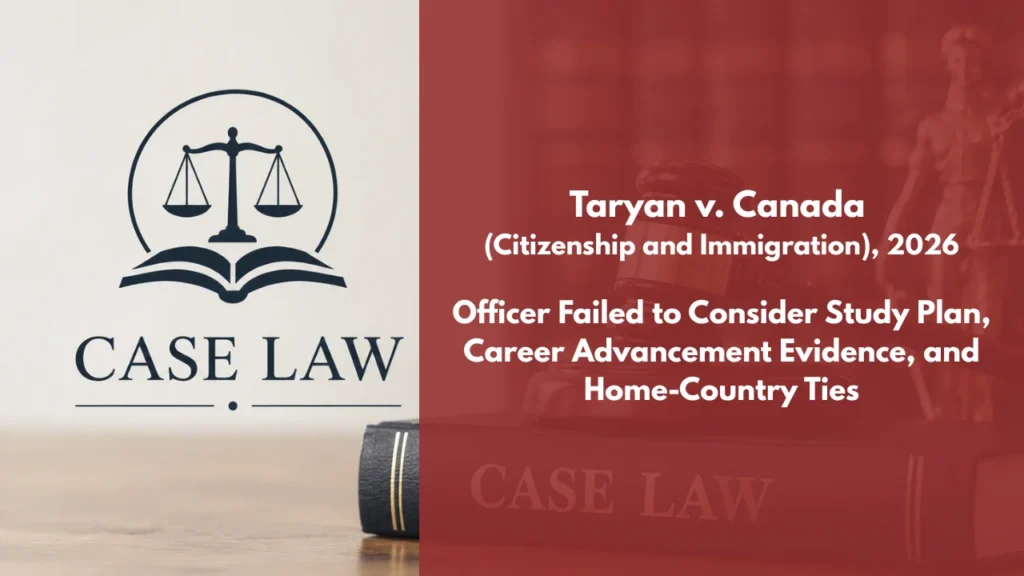
Federal Court granted judicial review after finding that a visa officer failed
to meaningfully engage with the applicant’s study plan, employment-related
evidence, and significant ties to Iran. The Court held that it was unreasonable
to conclude that the applicant already possessed sufficient education and
experience without addressing evidence explaining why the proposed Canadian
degree was necessary for career advancement.
Key
Principle
The
decision confirms that visa officers must meaningfully assess an applicant’s
study plan, career advancement rationale, and home-country ties. A refusal is
unreasonable where an officer ignores evidence explaining why further education
is necessary and fails to consider factors supporting the applicant’s intention
to return home after completing studies.
Background
Sobhan
Taryan, a citizen of Iran, applied for a study permit to pursue a four-year
Bachelor of Computing Science degree at Trinity Western University in British
Columbia.
The
applicant already held an associate degree in information technology and worked
as an IT Expert in Iran. He submitted evidence that his employer had offered
him a promotion to IT Director, conditional upon obtaining a computer science
degree from a developed country. His employer also approved a four-year leave
of absence to allow him to pursue the program.
In
addition, the applicant provided a detailed study plan explaining how the
proposed degree fit into his educational background, professional experience,
and long-term career objectives.
Despite
this evidence, the visa officer refused the application, concluding that the
applicant already had sufficient education, training, and experience in the IT
field and therefore had not established a genuine temporary purpose for
studying in Canada.
Court
Findings
Justice
Turley found the decision unreasonable because the officer failed to engage
with key evidence that directly addressed the officer’s concerns.
The
Court noted that the applicant had clearly explained why the Canadian degree
was necessary to secure a promotion and advance his career. Rather than
addressing this evidence, the officer simply assumed that the applicant’s
existing qualifications were sufficient and inferred that his true motivation
was immigration rather than education.
The
Court adopted earlier jurisprudence holding that officers cannot ignore an
applicant’s stated educational rationale and substitute unsupported assumptions
about educational necessity.
The
Court also found that the officer failed to assess important “push and pull
factors” relevant to temporary intent. The applicant had presented substantial
evidence demonstrating strong ties to Iran, including:
· An employer-approved leave of absence and conditional promotion;
· Both parents and two siblings residing in Iran;
· More than CAD $72,000 in savings;
· Ownership of two properties and three vehicles; and
· Positive international travel history.
The
officer failed to meaningfully address any of this evidence when concluding
that the applicant would not leave Canada at the end of his authorized stay.
The
Federal Court allowed the judicial review, set aside the study permit refusal,
and returned the matter to a different officer for reconsideration.
Citation:
Taryan v. Canada (Citizenship and
Immigration), 2026 FC 169 (CanLII)
Prepared by:
Dr. Muhammad Abrar (Barrister and Solicitor)
Author | Writer | Mentor | Legal Researcher | Canadian Immigration Case Law and Statistics Analyst