The
Federal Court reviewed the refusal of a study permit application submitted by
an Indian applicant seeking to pursue a post-graduate diploma in Web Design
after already obtaining bachelor’s and master’s degrees in computer science and
working as a computer teacher. The visa officer concluded that the proposed
program did not represent a logical educational progression and was not
satisfied that the applicant would leave Canada at the end of her authorized
stay. The Court dismissed the application for judicial review, finding that the
officer reasonably assessed the study plan and that the applicant failed to
adequately explain the educational and professional benefits of the proposed
program.
Key
Principle
While
visa officers must meaningfully consider an applicant’s study plan, the
applicant bears the burden of demonstrating how the proposed program logically
advances their education or career. Where a study plan fails to explain why a
lower-level or different program provides meaningful professional benefits, an
officer may reasonably conclude that the proposed studies do not represent a
logical progression and refuse the application.
Background
Amritpreet
Kaur, a citizen of India, held both a bachelor’s and a master’s degree in
computer science and had work experience as a computer teacher at a senior
secondary school. She applied for a study permit to attend a post-graduate
certificate program in Web Design at the University of Winnipeg.
In
support of her application, she submitted academic records and a Statement of
Purpose describing her educational background, financial circumstances, and her
interest in pursuing a career in web development. The visa officer refused the
application after finding that the applicant already possessed qualifications
exceeding the proposed program and had not demonstrated why pursuing the
diploma was a logical educational progression.
Court
Findings
· Officer Reasonably Engaged with the Study Plan
The
Court rejected the argument that the officer ignored the applicant’s Statement
of Purpose. Justice Whyte Nowak found that the officer expressly considered the
study plan but reasonably concluded that it failed to explain how the proposed
diploma in web design would enhance the applicant’s existing education and
professional experience in computer science. The reasons reflected an
assessment of the evidence rather than a boilerplate rejection.
· Applicant Bears the Burden of Demonstrating Educational
Progression
The
Court emphasized that it is the applicant—not the officer—who bears the
responsibility of demonstrating the benefits of the proposed studies. While
previous Federal Court decisions have held that possessing higher academic
qualifications alone is not sufficient to refuse a study permit, those cases
involved applicants who had clearly explained the career value of the proposed
program. In this case, the applicant’s Statement of Purpose lacked a meaningful
explanation connecting the diploma to her career advancement.
· New Evidence Cannot Cure Deficiencies on Judicial Review
The
applicant attempted to rely on additional course descriptions and supporting
materials during judicial review to demonstrate the value of the proposed
program. The Court held that this evidence was not before the officer when the
decision was made and could not be used to remedy deficiencies in the original
application. Judicial review assesses the reasonableness of the decision based
on the record that existed before the decision-maker.
Outcome
The
Federal Court dismissed the application for judicial review, finding that the
officer reasonably concluded the applicant had failed to establish a logical
educational progression or adequately explain the benefits of pursuing the
proposed diploma. The decision reinforces that applicants must provide clear
and persuasive evidence connecting their proposed studies to their career
objectives at the time of the application.
Case
Citation:
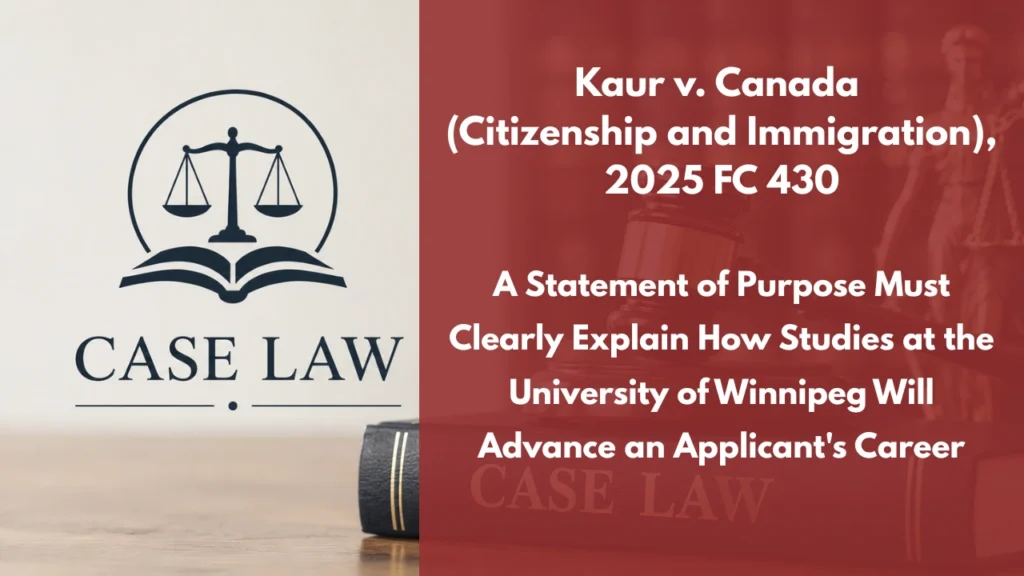
Kaur v. Canada (Citizenship and Immigration), 2025 FC 430 (CanLII)
Prepared by:
Dr. Muhammad
Abrar (Barrister and
Solicitor)
Author | Writer | Mentor | Legal Researcher | Canadian Immigration Case Law and
Statistics Analyst