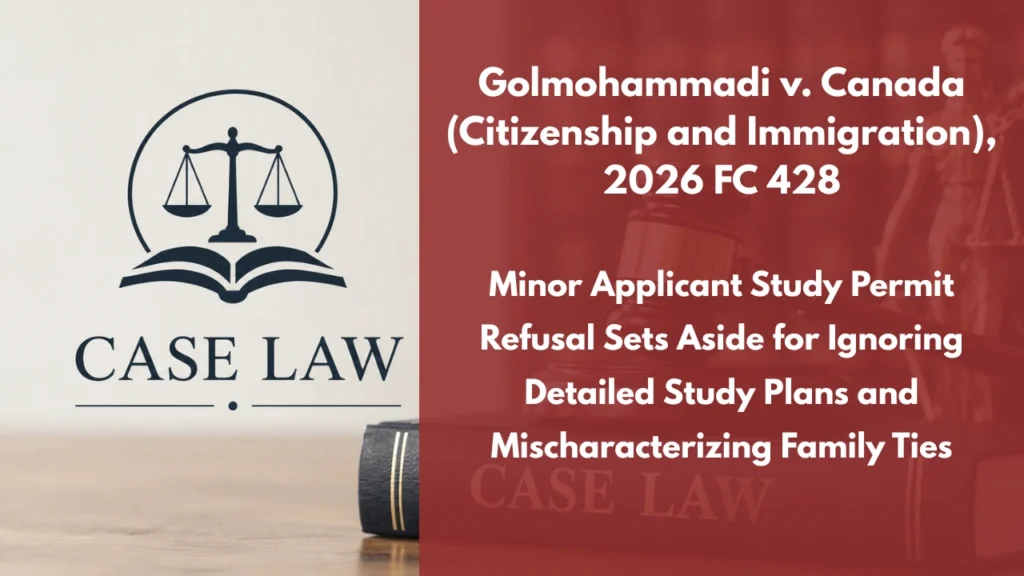
The
Federal Court granted judicial review of study permit refusals issued to two
minor applicants and the accompanying temporary resident visa refusal for their
mother. The Court found that the visa officer failed to meaningfully engage
with the applicants’ detailed study plans and overlooked critical evidence
regarding their family ties to Iran. The decision reinforces that visa officers
must meaningfully assess the evidence and submissions before them and cannot
rely on generalized conclusions when evaluating the purpose of studies or an
applicant’s intention to leave Canada at the end of the authorized period of
stay.
Key
Principle
A
study permit refusal is unreasonable where a visa officer fails to meaningfully
engage with an applicant’s study plan or overlooks material evidence concerning
family ties and temporary intent. Decision-makers must respond to the substance
of the evidence submitted and explain why that evidence does not satisfy the
statutory requirements. Unsupported or generalized conclusions that ignore
contradictory evidence fail to meet the standards of justification,
transparency, and intelligibility established in Vavilov.
Background
The
minor applicants, citizens of Iran, were accepted into the Toronto District
School Board and applied for study permits to pursue their secondary education
in Canada. Their mother simultaneously applied for a temporary resident visa to
accompany them during their initial transition and adjustment period.
The
applications were initially refused and later reopened following judicial
review proceedings. After the applicants submitted updated documentation and
revised study plans, the visa officer again refused the applications. The
officer concluded that the study plans did not adequately explain how studying
in Canada would benefit the applicants and found that their family ties to Iran
were insufficient to ensure they would return upon completing their studies.
Because the study permit applications were refused, the accompanying temporary
resident visa application submitted by the mother was also denied.
Court
Findings
· The Officer Failed to Meaningfully Consider the Applicants’
Study Plans
The
Court held that the officer’s conclusion that the study plans contained only
generalized statements was inconsistent with the evidence before them. The
applicants had provided detailed explanations outlining the advantages of a
Canadian education, including stronger post-secondary opportunities, improved
English language proficiency, early integration into Canadian society, and
deficiencies in Iran’s educational system. By failing to address these specific
submissions, the officer did not meaningfully engage with the evidence and
therefore rendered an unreasonable decision.
· The Officer Ignored Material Evidence Regarding Family Ties
The
Court also found that the officer overlooked significant evidence demonstrating
the applicants’ continuing ties to Iran. Although the officer concluded that
the applicants’ immediate family would relocate to Canada, the evidence
established that their father and brother would remain in Iran and that their
mother intended only a temporary stay before returning to her employment.
Ignoring this evidence led to an unreasonable assessment of the applicants’
motivation to return home after completing their studies.
· The Mother’s Temporary Resident Visa Refusal Could Not
Stand
Because
the mother’s temporary resident visa application was refused solely as a
consequence of the children’s study permit refusals, the Court concluded that
her refusal could not survive once the underlying study permit decisions were
found to be unreasonable.
Outcome
The
Federal Court granted the application for judicial review, set aside the
refusals of both study permit applications and the accompanying temporary
resident visa application, and returned all three applications to a different
visa officer for redetermination. The decision confirms that visa officers must
meaningfully assess detailed study plans and carefully consider all material
evidence relating to family ties and temporary intent before refusing study
permit applications.
Case
Citation:
Golmohammadi v. Canada (Citizenship and Immigration), 2026 FC 428 (CanLII)
Prepared by:
Dr. Muhammad
Abrar (Barrister and
Solicitor)
Author | Writer | Mentor | Legal Researcher | Canadian Immigration Case Law and
Statistics Analyst