Introduction
The
Federal Court considered a judicial review of an Immigration Appeal Division
(IAD) decision refusing a spousal sponsorship application. Although the
Canadian sponsor presented extensive evidence demonstrating an ongoing
relationship, the IAD concluded that the sponsored spouse entered the marriage
primarily to obtain immigration status in Canada. The Court upheld the IAD’s
decision, confirming that under the amended section 4 of the Immigration and
Refugee Protection Regulations, either a lack of genuineness or an improper
immigration purpose is sufficient to refuse sponsorship.
Key
Principle
A
genuine and continuing relationship does not automatically satisfy the
requirements of section 4 of the Immigration and Refugee Protection
Regulations. A sponsorship may still be refused where the evidence establishes
that one spouse entered the marriage primarily to obtain immigration status or
another immigration benefit. The intentions of each spouse must be assessed
individually, and the primary purpose of even one spouse can determine the
outcome.
Background
The
Canadian sponsor married a Mexican citizen who had previously made an
unsuccessful refugee claim in Canada and was subject to a removal order. After
his return to Mexico, the couple maintained their relationship through regular
communication, annual visits, financial support, and documentary evidence
demonstrating their ongoing commitment.
The visa officer refused the sponsorship, finding that the marriage had been entered into primarily for immigration purposes. On appeal, the IAD accepted that the sponsor was a credible witness and acknowledged substantial evidence supporting the continuation of the relationship. Nevertheless, it concluded that the sponsored spouse’s primary motivation for marrying was to remain in or return to Canada through the sponsorship process. The sponsor sought judicial review of that decision.
Court
Findings
- Primary Purpose May Differ Between the Two Spouses
The Court emphasized that section 4 requires an
examination of the intentions of each spouse. While one spouse may genuinely
intend to establish a lifelong marriage, the other may primarily seek
immigration status. The existence of a sincere commitment by one party does not
prevent a finding that the marriage falls within the bad-faith provisions of
the Regulations.
- Evidence of an Ongoing Relationship Does Not Resolve Primary Purpose
The Court accepted that the sponsor had made genuine
financial and emotional sacrifices, including supporting her husband
financially, travelling to Mexico regularly, maintaining frequent
communication, and providing documentary evidence of the relationship. However,
these factors did not outweigh the evidence suggesting that the sponsored
spouse’s principal motivation at the time of the marriage was to secure
immigration status in Canada.
- Amended Section 4 Applies to IAD Appeals
The Court confirmed that because IAD appeals are
heard de novo, the amended version of section 4—which introduced the
disjunctive test—applied to appeals heard after the legislative amendment.
Accordingly, a sponsorship application may fail if either the relationship is
not genuine or the marriage was entered into primarily for immigration
purposes.
Outcome
The
Federal Court dismissed the application for judicial review, finding that the
IAD reasonably concluded that the sponsored spouse entered the marriage
primarily to obtain an immigration benefit, despite evidence that the sponsor
genuinely believed in the relationship and continued to support it after the
marriage.
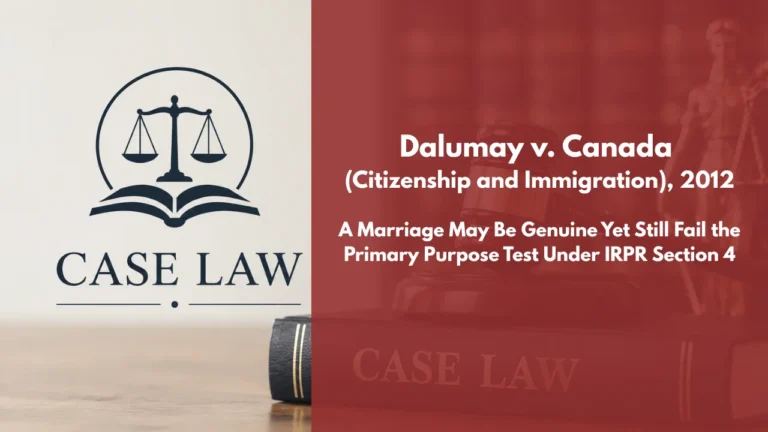
Case Citation: Dalumay v. Canada (Citizenship and Immigration), 2012 FC 1179 (CanLII)
Prepared by:
Dr. Muhammad Abrar (Barrister and Solicitor)
Author | Writer | Mentor | Legal Researcher | Canadian Immigration Case Law and Statistics Analyst