Introduction
The
Federal Court reviewed the refusal of study permit applications submitted by
two minor applicants seeking to study in Canada, along with a temporary
resident visa application submitted by their mother. The visa officer refused
the study permit applications based on concerns regarding the applicants’ study
plans and whether they had sufficient motivation to return to Iran after
completing their studies. The mother’s temporary resident visa application was
refused as a consequence of the refusal of her children’s applications. The
Court granted judicial review, finding that the officer failed to meaningfully
engage with the evidence and submissions provided regarding the applicants’
educational plans and family ties in Iran.
Key
Principle
A
visa officer must meaningfully consider the evidence and submissions provided
by an applicant when assessing a study permit application. While officers are
not required to address every piece of evidence, their reasons must demonstrate
that they engaged with the central issues raised by the applicant.
Background
The
minor applicants, citizens of Iran, applied for study permits after being
accepted to study with the Toronto District School Board. Their mother applied
for a temporary resident visa to accompany them to Canada and assist them with
adjusting to life in Canada while they began their studies.
The
applications were initially refused in January 2024 but were reopened for
redetermination after judicial review proceedings were started. The applicants
provided updated documents and further information before the applications were
refused again in August 2024.
The
officer refused the study permit applications on two grounds. First, the
officer found that the applicants’ study plans did not sufficiently explain how
their proposed Canadian education would benefit them at their current stage of
life. Second, the officer found that the applicants did not have sufficiently
strong family ties to Iran to motivate their return. The mother’s temporary
resident visa application was refused because it was based on the refusal of
her children’s study permit applications.
Court
Findings
· Failure to Consider Detailed Study Plans
The
Court found that the officer’s concerns about the applicants’ study plans did
not correspond with the evidence submitted. The study plans contained detailed
explanations regarding the benefits of Canadian education, including the
quality of Canadian post-secondary education, the importance of studying in
English, and the applicants’ future goals of pursuing careers in nursing and
medicine.
The
applicants also explained that entering the Canadian education system earlier
would help them adapt culturally, improve their language skills, and prepare
for future education. The Court held that the officer failed to engage with
these submissions and instead relied on a general conclusion that the study
plans lacked sufficient detail.
· Failure to Address Evidence of Family Ties
The
Court also found that the officer failed to consider important evidence
relating to the applicants’ family ties in Iran. The officer concluded that the
applicants’ ties to Iran were weak because their immediate family members would
accompany them to Canada. However, the officer failed to address evidence that
the applicants’ father and brother would remain in Iran.
The
officer also failed to consider that the mother’s stay in Canada was intended
to be temporary and that she planned to return to her employment in Iran after
assisting her children’s adjustment. This evidence directly contradicted the
officer’s conclusion that the applicants lacked sufficient motivation to
return.
· Decision Lacked Responsiveness Under Vavilov
The
Court held that the refusal decisions were unreasonable because the officer did
not meaningfully engage with the central evidence and submissions. The issue
was not that the officer reached an unfavourable conclusion, but that the
reasoning did not demonstrate consideration of the information provided by the
applicants.
Outcome
The
Federal Court granted the application for judicial review, set aside the
refusals of the study permit and temporary resident visa applications, and
returned the matters to a different officer for redetermination. No question
was certified for appeal.
Case
Citation:
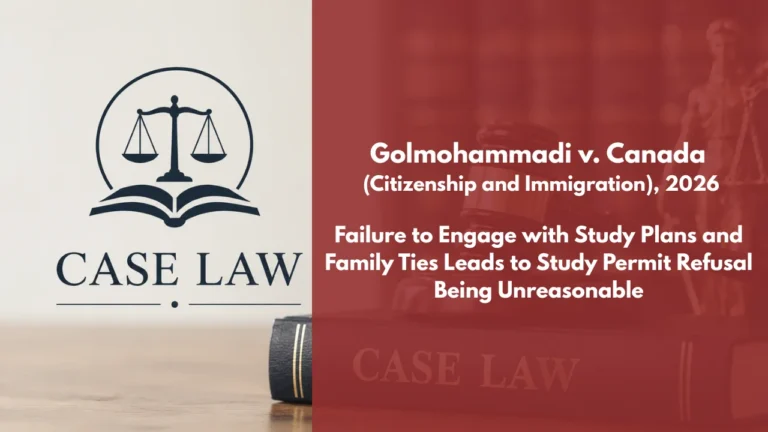
Golmohammadi v. Canada (Citizenship and Immigration), 2026 FC 428 (CanLII)
Prepared by:
Dr. Muhammad Abrar (Barrister and Solicitor)
Author | Writer | Mentor | Legal Researcher | Canadian Immigration Case Law and Statistics Analyst