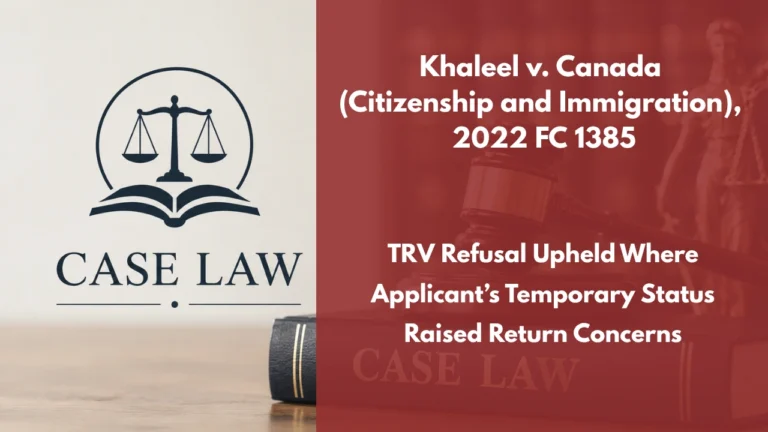
The Federal Court reviewed
Muhammad Khaleel’s TRV refusal for an exploratory visit required by the British
Columbia Entrepreneur Immigration Regional Pilot. The officer was not satisfied
he would leave Canada after the visit, relying on purpose of visit, temporary
status and employment in Saudi Arabia, and immigration history. The Court found
the decision reasonable.
Key Principle
A TRV officer may assess
temporary intent using immigration history, employment stability, third-country
status, and general local conditions. Officers may rely on publicly available
country information without prior notice, and judicial review does not permit
reweighing evidence merely because positive evidence could support another
conclusion.
Background
The applicant, a Pakistani
citizen working temporarily in Saudi Arabia, was invited to Quesnel for an
exploratory visit and interview connected to his entrepreneur nomination
application. He proposed a short visit and disclosed substantial funds. His wife
and children remained in Pakistan, while he had worked in Saudi Arabia since
2016.
Court Findings
• Saudization Concerns Were
Reasonably Considered
The officer noted that Saudi
Arabia’s Saudization policies prioritized citizens over foreign workers and
that pandemic-related labour changes increased pressure on the foreign
workforce. The employer’s letter showing increased bakery demand did not answer
the broader concern that the applicant’s continued employment depended on
temporary foreign-worker status within that policy environment.
• Officer Did Not Ignore
Applicant’s Employment Role
The applicant argued that the
officer overlooked his operational responsibilities. The GCMS notes described
him as a senior manager in sales and operations. The Court found that his
duties did not alter the concern about employment instability arising from
foreign-worker status.
• Purpose of Visit Was
Acknowledged and Weighed
The officer expressly recognized
that the visit was for an exploratory trip and interview connected to the
entrepreneur program. The Court rejected the argument that supporting correspondence
was ignored. Decision-makers need not mention every document when the central
purpose is understood.
• Immigration History
Supported Compliance Concerns
The applicant’s history included
a refused refugee claim, removal to Pakistan, a later attempt to return using a
cancelled TRV that resulted in another removal and exclusion order, and
subsequent TRV refusals. The officer could reasonably treat this history as
relevant to whether he was a bona fide temporary visitor likely to comply with
conditions.
• Family Ties Did Not Compel a
Different Result
The officer was aware that the
applicant’s spouse and children lived in Pakistan. However, he had lived
separately in Saudi Arabia for years, and the Court held that the strength of
those ties was a factual matter entitled to deference. Their existence did not
make the overall temporary-intent assessment unreasonable.
• No Procedural Fairness
Breach from Country Information
The applicant argued that
reliance on Saudization and economic conditions was extrinsic evidence
requiring notice. The Court disagreed. TRV applicants receive a relatively low
level of procedural fairness, and officers may use general knowledge of local conditions
and public information when assessing temporary intent. The applicant could
reasonably have anticipated scrutiny of his temporary status and employment
stability.
Outcome
The Federal Court dismissed
judicial review. The officer’s assessment of employment prospects, purpose of
visit, family ties, immigration history, and local conditions was justified,
intelligible, and transparent. No question of general importance was certified.
Case
Citation:
Khaleel v. Canada (Citizenship and Immigration), 2022 FC 1385 (CanLII)
Prepared by:
Dr. Muhammad
Abrar (Barrister and
Solicitor)
Author | Writer | Mentor | Legal Researcher | Canadian Immigration Case Law and
Statistics Analyst