The Federal Court reviewed the
refusal of Azubuike Celestine Ohaleta’s study permit application for a two-year
Master of Arts in Theological Studies. The officer was not satisfied that the
applicant would leave Canada, relying on alleged insufficient funds and an
unreasonable study plan. The Court granted judicial review because both
conclusions materially misapprehended the evidence.
Key Principle
An officer assessing a study
permit must consider the applicant’s available financial resources as a whole
and cannot disregard documented accounts or third-party financial support
without explanation. Similarly, age and existing professional experience do not
make further education unreasonable where the proposed program is directly
connected to the applicant’s established career and future professional
objectives.
Background
The applicant was a 47-year-old
pastor who had worked at a church since 2007. He already held a Bachelor of
Theology and a postgraduate education degree but sought advanced theological
studies to improve his theological knowledge and develop leadership and
organizational skills. He intended to return to his existing pastoral career
after graduation.
Court Findings
• Officer Understated the
Applicant’s Available Financial Resources
The officer treated the applicant
as having approximately $13,000 in savings. However, the record showed
approximately $12,447 in a Nigerian savings account, about $11,146 in a
US-dollar account, and approximately $10,000 in a GIC, substantially increasing
the funds available for his studies.
• Other Financial Resources
Were Ignored Without Explanation
The applicant also indicated that
a fellow church member would provide financial support. The Court found it
unreasonable for the officer to conclude that the applicant could not afford
his studies without explaining why the additional savings accounts and sponsor
support were unavailable or insufficient.
• Proposed Studies Were
Directly Related to the Applicant’s Career
The applicant had worked as a
pastor for approximately 15 years and sought an advanced degree in theology.
The Court found an obvious connection between the proposed education and his
established vocation, including his stated objective of improving his leadership,
organizational, and theological skills for continued pastoral work.
• Applicant’s Age Did Not
Rationally Undermine the Study Plan
The officer relied partly on the
applicant being 47 years old. The Court found nothing about that age suggesting
an inability to undertake graduate studies or making the educational objective
inherently unreasonable. Age alone did not provide a rational basis for
questioning the genuineness or usefulness of the proposed studies.
• Alleged Redundancy Required
Actual Analysis
The officer apparently viewed the
program as unnecessary because of the applicant’s prior education and
professional experience. The Court held that further education cannot simply be
dismissed as redundant without explaining why additional specialized training
would provide no meaningful professional benefit.
• Reasons Lacked Transparency
on Both Central Grounds
The financial and study-plan
findings were central to the refusal, yet neither was supported by an adequate
analysis of the evidence. The Court therefore could not trace a rational path
from the record to the conclusion that the applicant was not a genuine
temporary student.
Outcome
The Federal Court granted
judicial review and remitted the study permit application to a different
officer for reconsideration. No question was certified.
Case
Citation:
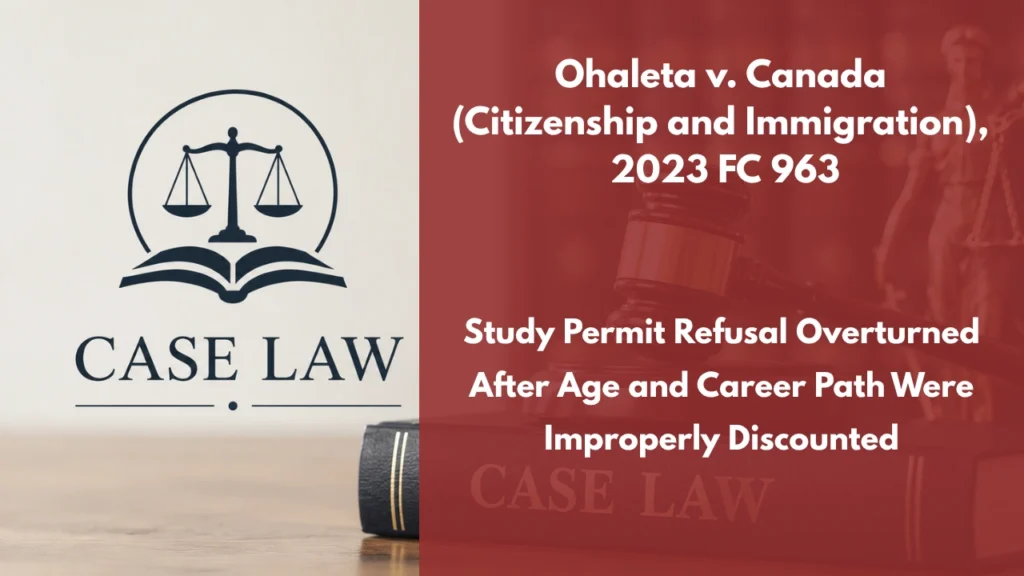
Ohaleta v. Canada (Citizenship and Immigration), 2023 FC 963 (CanLII)
Prepared by:
Dr. Muhammad
Abrar (Barrister and
Solicitor)
Author | Writer | Mentor | Legal Researcher | Canadian
Immigration Case Law and Statistics Analyst