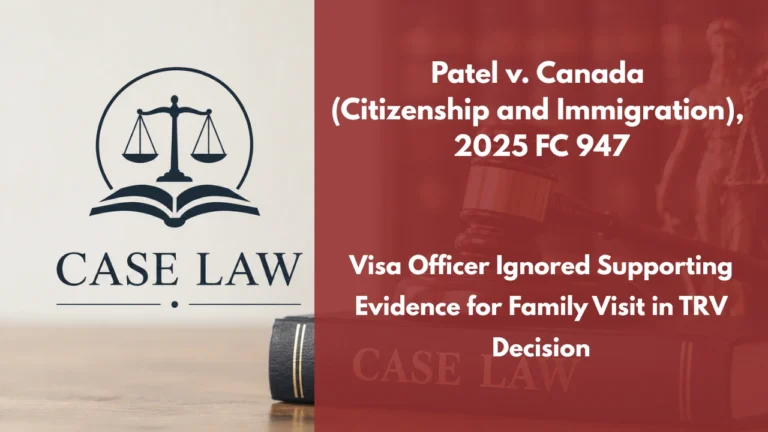
The Federal Court reviewed IRCC’s refusal of Irfan Saeed
Patel’s temporary resident visa application. The applicant, a citizen of India,
wished to visit Toronto for two weeks to attend his niece’s birthday. The
officer refused the application because the applicant’s finances were
considered insufficient and the purpose of his visit was said to be
inconsistent with a temporary stay. The Court granted judicial review, finding
that the officer provided no rational explanation for concluding that the
proposed family visit was not temporary.
Key Principle
Visa officers may provide brief reasons, but their decisions
must still contain a rational chain of analysis connecting the evidence to the
outcome. Where an applicant provides a specific travel purpose and evidence of
obligations requiring a return home, an officer must explain why that evidence
is insufficient. A bare statement that the purpose of travel is inconsistent
with a temporary stay does not satisfy the requirements of justification,
transparency, and intelligibility.
Background
The applicant was a business owner in India and helped care
for his mother. His brother lived in Toronto.
In November 2023, the applicant applied for a temporary
resident visa to attend his niece’s birthday celebration. His brother sponsored
the visit and confirmed that the applicant intended to remain in Canada for
approximately two weeks.
The application included bank statements, land valuation
reports, an income tax acknowledgment, a business registration certificate, and
a sponsorship letter from the applicant’s brother. The sponsor’s letter also
explained that the applicant had operated his own business in India since
January 2018 and would return to continue caring for his mother.
On December 5, 2023, the officer refused the application.
The officer found insufficient evidence regarding the origin of the applicant’s
funds and stated that the purpose of the visit was not consistent with a
temporary stay.
The applicant argued that the financial concern amounted to
a veiled credibility finding and that he should have been given an opportunity
to respond.
➢ Court Findings
• No Procedural Fairness Breach Occurred
The Court rejected the procedural fairness argument. The
bank records showed the dates and amounts of deposits but did not identify
their sources. The officer did not accuse the applicant of dishonesty or
disbelieve his evidence.
Because temporary resident visa applicants bear the
responsibility of submitting sufficient evidence, the officer was not required
to request further information about the source of the funds.
• Temporary Purpose Finding Lacked Analysis
The Court found that the officer gave no explanation for
concluding that the visit was inconsistent with a temporary stay. The refusal
letter and GCMS notes merely repeated the conclusion.
• Evidence Supported a Short Family Visit
The sponsor’s letter clearly identified the purpose and
duration of the trip. It also confirmed the applicant’s continuing business and
caregiving responsibilities in India. These statements were supported by the
business registration certificate and Family Information Form.
Although the applicant’s evidence was not extensive, it was
sufficiently detailed to require meaningful consideration. The Court noted that
visits to close family members are understandable and are a recognized purpose
for temporary resident visas.
Outcome
The Federal Court granted judicial review because the
officer’s decision was not justified, transparent, or intelligible. The
temporary resident visa refusal was set aside. No question was certified.
Case Citation:
Patel v. Canada (Citizenship and Immigration), 2025 FC 947 (CanLII)
Prepared by:
Dr. Muhammad
Abrar (Barrister and
Solicitor)
Author | Writer | Mentor | Legal Researcher | Canadian Immigration Case Law and
Statistics Analyst