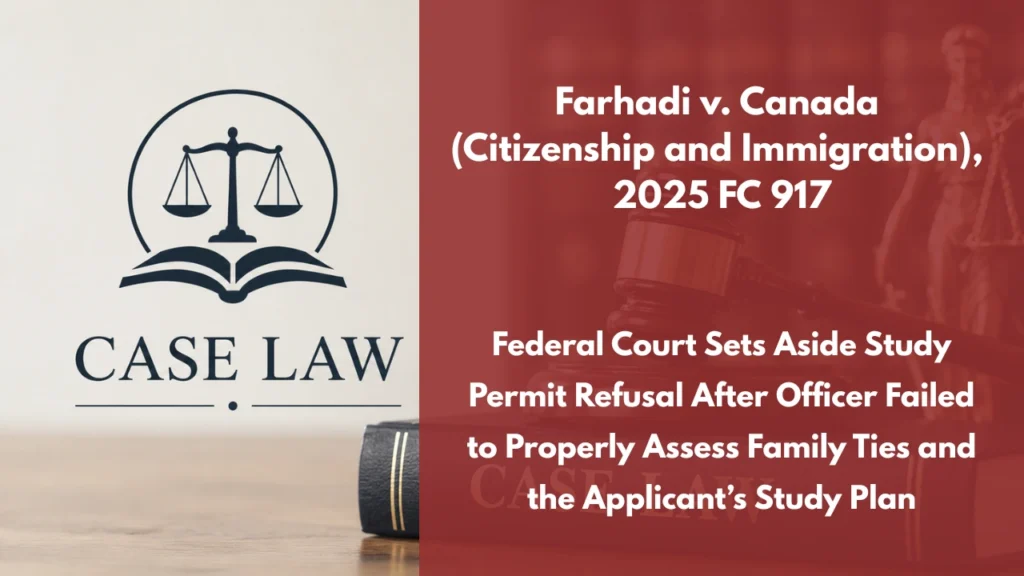
The Federal Court reviewed IRCC’s refusal of Mahboubeh
Farhadi’s study permit application, together with the related applications of
her spouse and child. She intended to complete English-language studies
followed by a two-year postgraduate certificate in Human Resources, Marketing
and Entrepreneurship at Trent University. The officer found that the studies
were unreasonable and that travelling with her family weakened her ties to
Iran. The Court granted judicial review because the officer failed to assess her
remaining ties to Iran and the evidence connecting the program to her career
and business plans.
Key Principle
An officer may consider that an applicant’s spouse and child
will accompany them to Canada, but must also weigh family, employment,
business, property, and financial ties to the home country. An officer may
question whether a program is redundant, but must explain how prior education
or employment already provided its benefits. Explanations connecting the
studies to future employment or business goals must be considered.
Background
The applicant was a 29-year-old Iranian citizen with a
bachelor’s degree in project management. Her work history included employment
as a dental assistant, an executive manager and accountant at a dental clinic,
and an accountant and finance manager at Saba Electric. She had also completed
fashion-design training and established a sewing workshop.
Her study plan explained that the combined program would
provide knowledge in human resources, marketing, entrepreneurship, social
innovation, online marketing, and new-venture planning that was not available
in one program in Iran. She connected these subjects to expanding her sewing
workshop and advancing her employment.
The officer concluded that her previous experience meant she
had already obtained the program’s benefits. The officer also found that her
motivation to return to Iran would diminish because her spouse and child would
accompany her.
Court Findings
• Remaining Ties to Iran Were Not Weighed
The officer could consider the accompanying spouse and child
as factors pulling the applicant toward Canada. However, the officer did not
assess the applicant’s and her spouse’s remaining family ties and establishment
in Iran. The analysis was incomplete.
• Prior Work Did Not Make the Program Redundant
The Court found it difficult to understand how work as a
dental assistant, accountant, or finance manager had already provided the
benefits of a program focused on human resources, marketing, and
entrepreneurship. The officer did not identify meaningful overlap between her
duties and the curriculum.
• Business Rationale Was Ignored
The applicant explained how courses would help her recruit
and train employees, market products, develop new ventures, and expand her
sewing workshop. The officer did not engage with this evidence or explain why
the program was not progression for her business.
• No Procedural Fairness Breach Occurred
The Court rejected the argument that the officer was
required to seek clarification. The concerns related to evidentiary
sufficiency, not credibility, authenticity, or undisclosed information.
Outcome
The Federal Court granted judicial review, set aside the
refusal, and returned the matter to a different officer for redetermination.
The spouse’s and child’s applications had also been refused because they
depended on the principal application. No question was certified.
Case Citation:
Farhadi v. Canada (Citizenship and Immigration), 2025 FC 917 (CanLII)
Prepared by:
Dr. Muhammad
Abrar (Barrister and
Solicitor)
Author | Writer | Mentor | Legal Researcher | Canadian Immigration Case Law and
Statistics Analyst