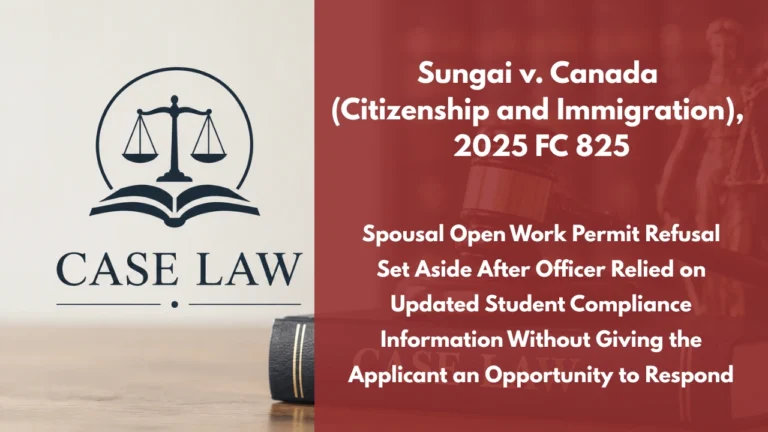
The Federal Court reviewed IRCC’s refusal of Munashe
Sungai’s open work permit application. The applicant, a citizen of Zimbabwe
living in Canada as a temporary resident, applied to accompany his spouse, who
held a study permit. The officer refused the application after consulting the
student compliance portal and concluding that the spouse was no longer actively
pursuing full-time studies. The Court granted judicial review because the
officer relied on changed information without allowing the applicant to explain
that his spouse was on an authorized pregnancy-related medical leave.
Key Principle
Procedural fairness protections in visa and work permit
applications are limited, but they are not meaningless. Applicants must
generally provide complete evidence and establish eligibility. However, where
an officer questions the accuracy or continuing truth of information that was
accurate when submitted, the officer may be required to provide notice and an
opportunity to respond. A refusal based on later information may be unfair if
clarification could resolve the concern.
Background
The applicant applied for an open work permit on November
25, 2023, to accompany his spouse in Canada. At that time, she held a valid
study permit, was enrolled full-time, and was actively pursuing her studies.
In February 2024, the spouse took an institutionally
approved leave of absence because of pregnancy. She understood that she could
retain full-time status and continue to be regarded as actively pursuing her
studies if she resumed within 150 days.
When assessing the application, the officer consulted IRCC’s
student compliance portal on April 29, 2024. The portal showed that the spouse
was no longer registered but did not explain that she was on medical leave.
Without requesting clarification, the officer refused the work permit on June
4, 2024.
The applicant argued that the officer should have requested
updated information because the original evidence was accurate when submitted.
Court Findings
• Application Met the Requirements When Submitted
The Court found that November 25, 2023 was the operative
date for assessing the application. At that time, the spouse was a full-time
student actively pursuing her program, and the submitted information was
accurate.
• Later Portal Information Required Clarification
The compliance portal created an apparent conflict with the
original application. The issue was not whether the applicant had submitted
insufficient evidence, but whether previously accurate information still
reflected the spouse’s circumstances.
• Applicant Was Denied an Opportunity to Respond
The officer did not notify the applicant that the spouse’s
registration status had become a concern. Had clarification been requested, the
applicant could have explained the approved pregnancy-related leave and its
effect on her status.
• Procedural Fairness Was Breached
The Court held that the applicant did not know the case he
had to meet and was denied a fair opportunity to respond. Because this finding
was decisive, the Court did not determine whether the refusal was substantively
unreasonable.
Outcome
The Federal Court granted judicial review, set aside the
June 4, 2024 refusal, and returned the open work permit application to a
different officer for redetermination. No question was certified.
Case Citation:
Sungai v. Canada (Citizenship and Immigration), 2025 FC 825 (CanLII)
Prepared by:
Dr. Muhammad
Abrar (Barrister and
Solicitor)
Author | Writer | Mentor | Legal Researcher | Canadian Immigration Case Law and
Statistics Analyst