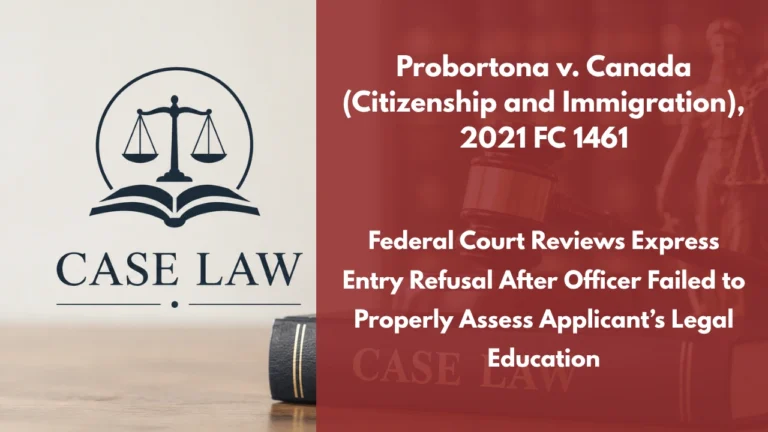
The Federal
Court reviewed IRCC’s refusal of Shaikh Probortona’s permanent residence
application under the Federal Skilled Worker Program. The officer reduced her
Comprehensive Ranking System score after determining that her educational
credentials did not support the points claimed in her Express Entry profile.
The Court granted judicial review because the officer failed to properly assess
whether her legal qualifications constituted a professional degree required to
practise in a licensed profession and did not adequately explain how her
education should have been classified.
Key
Principle
The Federal
Court confirmed that an officer assessing educational credentials must
meaningfully engage with both the credential assessment and the applicable
Express Entry educational categories. Where an applicant’s qualifications
potentially fit more than one component of a listed category, an officer cannot
focus on only one component and ignore relevant evidence supporting the other.
The decision must transparently explain the educational classification and
resulting CRS assessment.
Background
Ms.
Probortona, a Bangladeshi citizen, held a Bachelor of Laws and a Postgraduate
Diploma in Professional Legal Skills. She was also a qualified Barrister in
England and Wales. ICAS assessed her credentials as equivalent to a Canadian
Bachelor’s Degree and Post-Bachelor’s Diploma.
When
initially checking her Express Entry eligibility, the IRCC webpage allowed her
to select “Two or more certificates, diplomas, or degrees.” However, that same
option was unavailable when she completed her Express Entry profile.
She instead
selected “Master’s degree, or professional degree needed to practice in a
licensed profession” for her qualifications. This produced 126 education points
and contributed to a CRS score of 481. The invitation round cut-off was 478.
After she
submitted her permanent residence application, the officer adjusted her
education points based on the ICAS assessment. Her CRS score consequently fell
below the invitation threshold, and her application was refused.
Court
Findings
•
Educational Classification Was Not Transparently Explained
The officer
referred to Ms. Probortona’s credentials as a Bachelor’s Degree and
Post-Bachelor’s Diploma but did not explain which CRS educational category
applied. The Court found that this left uncertainty about how her education had
actually been assessed and why her claimed points were unavailable.
•
Professional Degree Component Was Overlooked
The selected
category referred not only to a master’s degree but also to a “professional
degree needed to practice in a licensed profession.” The officer focused on the
master’s degree component without meaningfully assessing the alternative
professional-degree component. This was significant because Ms. Probortona was
a practising Barrister and IRCC’s own guidance identified law as a professional
degree field.
• Express
Entry System Contributed to the Problem
The Court
noted that Ms. Probortona had reasonably relied on the electronic system. The
preliminary IRCC webpage and Express Entry profile presented different
educational options. Had consistent options been available, she could have
selected the category matching her ICAS assessment, received the lower score
initially, declined the invitation, and waited for a later invitation round
where her actual score was sufficient.
Outcome
The Federal
Court granted judicial review, set aside the permanent residence refusal, and
returned the application to another visa officer for redetermination. The Court
declined to award costs because the confusing IRCC system and unreasonable
decision did not constitute the special circumstances required for costs. No
question was certified.
Case Citation:
Probortona v. Canada (Citizenship and Immigration), 2021 FC 1461 (CanLII)
Prepared by:
Dr. Muhammad
Abrar (Barrister and
Solicitor)
Author | Writer | Mentor | Legal Researcher | Canadian Immigration Case Law and
Statistics Analyst