The
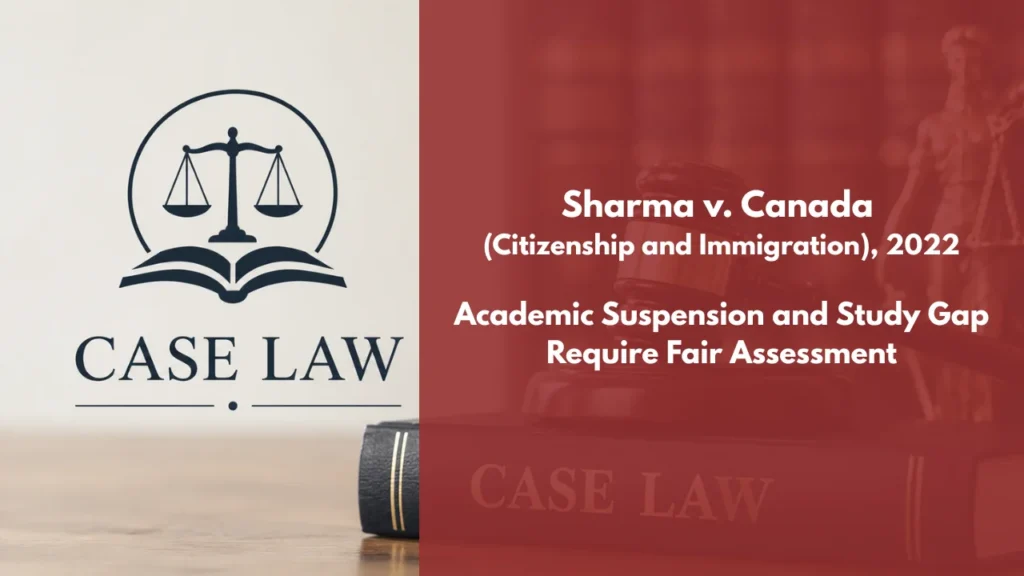
Federal Court set aside a PGWP refusal and related exclusion order arising from
a student’s academic suspension and gap in studies. The Court did not decide
whether the applicant’s absence was authorized. Instead, it found that CBSA
breached procedural fairness by relying on undisclosed information obtained
from the school about the suspension and alleged lack of approved leave.
Key
Principle
Where an officer relies on information obtained from a school to conclude
that an academic suspension or study gap was unauthorized, the student must be
given a meaningful opportunity to respond to that information. A procedural
fairness breach arises where an officer relies on undisclosed third-party
evidence in finding that a student failed to maintain full-time status.
Background
Karan
Sharma was enrolled in a two-year program in Québec. During his studies, he
became ill and stopped attending classes from November 2017 to early February
2018. He claimed that the school had verbally approved a medical leave and that
he had notified the school by email.
The
school later suspended him for non-attendance. Mr. Sharma maintained that the
suspension was later cancelled or reversed, and he was permitted to continue
his program. He ultimately completed the program in May 2019.
When
he applied for a PGWP, CBSA concluded that his study gap was not an authorized
leave. The officer found that he had failed to maintain full-time student
status and was therefore non-compliant with paragraph 220.1(1)(b) of the IRPR.
A section 44 report and exclusion order followed.
Court
Findings
The Federal Court found that the applicant’s academic suspension and
study gap were central to the officer’s finding of non-compliance.
After interviewing Mr. Sharma, the officer contacted an administrative
assistant at the school. The assistant reportedly advised that there was no
record of approved leave in the applicant’s student file. The officer relied on
this information as one of the reasons for concluding that the leave was
unauthorized.
However, the officer did not tell Mr. Sharma who had been contacted, what
questions were asked, or what information had been provided by the school.
The Court found that Mr. Sharma was not given a meaningful opportunity to
respond to this evidence. He could not address whether the school
representative had access to complete records, whether the suspension had been
cancelled, or why he had been allowed to resume and complete his program.
The Court held that asking Mr. Sharma to provide proof of authorized
leave was not enough. The officer had separately relied on information obtained
directly from the school, and procedural fairness required disclosure of that
information.
The Court also found that Mr. Sharma’s departure from Canada did not make
the case moot. A successful judicial review could still affect his future
ability to obtain a temporary resident visa or pursue a PGWP.
The
Federal Court allowed judicial review, quashed the PGWP refusal and exclusion
order, and returned the matter to a different CBSA officer for reconsideration.
Case Citation: Sharma v. Canada (Public Safety and Emergency Preparedness), 2022 FC 779 (CanLII)
Prepared by:
Dr. Muhammad Abrar (Barrister and Solicitor)
Author | Writer | Mentor | Legal Researcher | Canadian Immigration Case Law and Statistics Analyst