The
Federal Court considered whether a student who had stopped studying for more
than 150 days could avoid inadmissibility by arguing that he was exempt from
study permit conditions because he was in a common-law relationship with
another international student. The Court dismissed the judicial review, holding
that the applicant had never raised or established such an exemption before
immigration authorities and remained responsible for complying with the
conditions of his study permit.
Key
Principle
The
Court confirmed that the burden rests on foreign nationals to establish any
exemption from study permit conditions. Immigration officers are not required
to investigate or apply potential exceptions that are not clearly raised and
supported by evidence. A student who remains unenrolled beyond the permitted
period may be found inadmissible and subject to an exclusion order.
Background
Rohan
Karim entered Canada on a study permit to attend Memorial University of
Newfoundland. Following academic difficulties and the death of his grandmother,
he withdrew from his studies and remained unenrolled for more than 150 days.
CBSA subsequently prepared a report under subsection 44(1) of the Immigration
and Refugee Protection Act (IRPA), alleging that he had violated the
conditions of his study permit. A Minister’s Delegate later found the report
well-founded and issued an exclusion order.
Karim
argued that he should have been exempt from the study permit conditions because
he had been living in a common-law relationship with another foreign national
who held a valid study permit. He also claimed that CBSA failed to advise him
of this possible exemption and therefore breached procedural fairness.
Court
Findings
The
Federal Court rejected these arguments. Justice Grant held that the burden
rested on Karim to establish that he qualified for any exemption from the study
permit requirements. Although he mentioned having a partner during his
interviews, he never claimed common-law status, never submitted evidence
establishing a common-law relationship, and repeatedly identified himself as
“single” in immigration applications. Throughout his dealings with IRCC and
CBSA, he consistently applied as an independent student rather than as the
spouse or common-law partner of another permit holder.
The
Court found that the immigration officers reasonably concluded that Karim had violated
the conditions of his study permit by remaining unenrolled and not actively
pursuing his studies for an extended period. The fact that he had
re-enrolled by the time of the interviews did not cure the previous breach.
The Court also rejected the procedural fairness argument. In the context of section 44 inadmissibility proceedings, the duty of fairness is limited. Immigration officials were not required to identify and investigate every possible immigration category or exemption that might theoretically apply. Since Karim never raised the common-law exemption or provided evidence supporting it, the officers were under no obligation to assess it on their own initiative.
The Federal Court dismissed the judicial review and upheld the exclusion order.
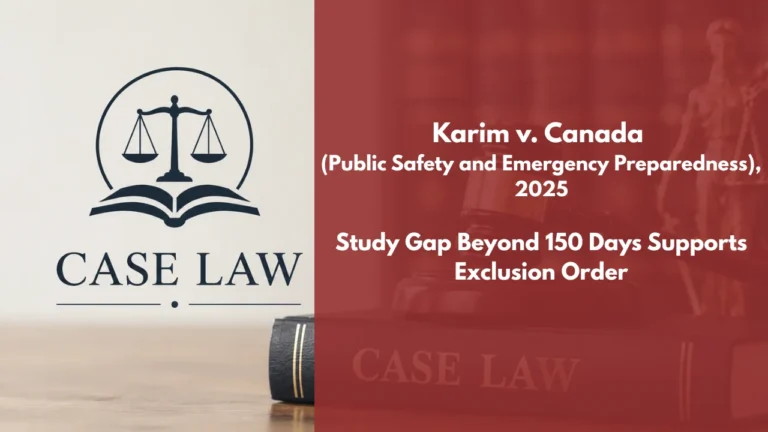
Case Citation: Karim v. Canada (Public Safety and Emergency Preparedness), 2025 FC 1467 (CanLII)
Prepared by:
Dr. Muhammad Abrar (Barrister and Solicitor)
Author | Writer | Mentor | Legal Researcher | Canadian Immigration Case Law and Statistics Analyst