Spousal sponsorship remains
one of the most popular pathways to permanent residence in Canada. If you are
living in Canada with your spouse or partner and planning to apply through the
Inland Spousal Sponsorship Program, understanding the process can help you
avoid unnecessary delays and prepare for each stage of the application.
Inland Spousal Sponsorship
allows a Canadian citizen or permanent resident to sponsor their spouse or
common-law partner who is currently residing in Canada. Applicants may also be
eligible for a Spousal Open Work Permit while their permanent residence application
is being processed.
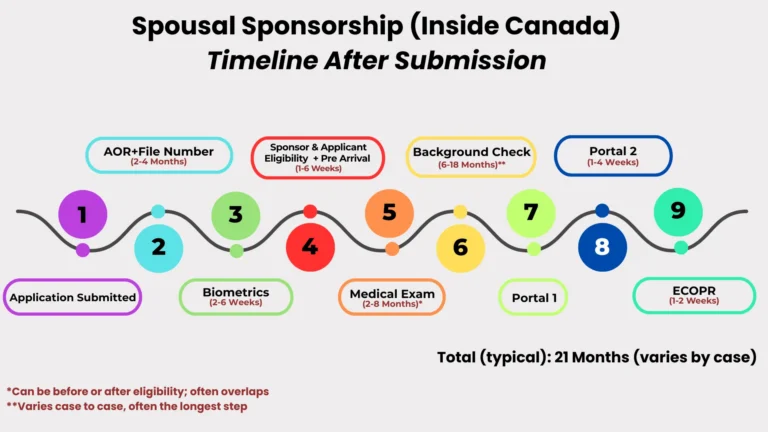
Step 1: Submit Your
Spousal Sponsorship Application
The process begins when the
sponsorship and permanent residence applications are submitted to Immigration,
Refugees and Citizenship Canada (IRCC).
A complete and properly
prepared application is essential. Missing documents, inconsistent information,
or insufficient relationship evidence can result in delays or requests for
additional information.
Step 2: Receive
Acknowledgment of Receipt (AOR)
Typically within 2 to 4
months, IRCC issues an Acknowledgment of Receipt (AOR), confirming that the
application has been received and entered into the system.
At this stage, applicants
receive their file number and, in most cases, become eligible to apply for a
Spousal Open Work Permit if they have not already done so.
Step 3: Biometrics
Request
Generally within 2 to 6
weeks after receiving instructions, applicants will be required to provide
biometrics, including fingerprints and a photograph.
Biometrics are used to
verify identity and support security screening throughout the immigration
process.
Step 4: Eligibility
Review
During the eligibility
assessment, immigration officers evaluate both:
- The sponsor’s eligibility to sponsor
- The principal applicant’s eligibility for
permanent residence
This stage often takes
between 1 and 6 weeks, although timelines can vary depending on the complexity
of the application and the information provided.
Step 5: Medical
Examination
Applicants are required to
complete an immigration medical examination conducted by an approved panel
physician. The medical request may arrive before or after eligibility review.
Most applicants receive medical instructions between 2 and 8 months after
application submission.
Completing the medical
examination promptly can help prevent unnecessary processing delays.
Step 6: Background and
Security Checks
The background verification
stage is often the longest and least predictable part of the spousal
sponsorship process.
During this phase, IRCC
conducts:
- Criminality checks
- Security screening
- Background verification
- Information validation
Processing times can vary
significantly depending on the applicant’s travel history, country of
residence, and individual circumstances.
Step 7: Portal 1
Invitation
Once the application is
approved, IRCC sends the Permanent Residence Portal 1 email.
This email is used to
confirm that the applicant is physically present in Canada and eligible to
complete the final permanent residence landing process electronically.
Step 8: Portal 2
Submission
After responding to Portal
1, applicants receive Portal 2 access.
At this stage, applicants
must submit:
- A digital photograph
- Current residential address in Canada
This information is used to
issue the Permanent Resident Card (PR Card).
Step 9: Receive eCOPR
The final stage is receiving
the electronic Confirmation of Permanent Residence (eCOPR).
In most cases, applicants
receive their eCOPR within 1 to 2 weeks after completing Portal 2 requirements.
Once the eCOPR is issued,
the applicant officially becomes a Permanent Resident of Canada.
Current Inland Spousal
Sponsorship Processing Times
According to current IRCC
processing data, inland spousal sponsorship applications may take approximately
24 months to process. However, actual timelines vary depending on application
volume, background checks, document completeness, and individual circumstances.
Common Reasons for Delays
Many sponsorship
applications experience delays due to:
- Incomplete application packages
- Insufficient relationship evidence
- Missing supporting documents
- Incorrect forms
- Failure to respond to IRCC requests on time
- Background or security screening issues
Preparing a thorough
application from the beginning can significantly reduce the risk of
complications.
Spousal sponsorship
applications are receiving increased scrutiny, and even genuine couples may
face requests for additional information or extended processing times.
At A&M Canadian
Immigration Law Corporation, we help couples prepare strong, well-documented
applications designed to minimize delays and address potential concerns before
they become issues.
If you are planning to sponsor your spouse or partner from inside Canada, contact A&M Canadian Immigration Law Corporation today to discuss your situation and ensure your application is prepared correctly from the start.
Written by:
Dr. Muhammad
Abrar (Barrister and
Solicitor)
Author | Writer | Mentor | Legal Researcher | Canadian Immigration Case Law and
Statistics Analyst