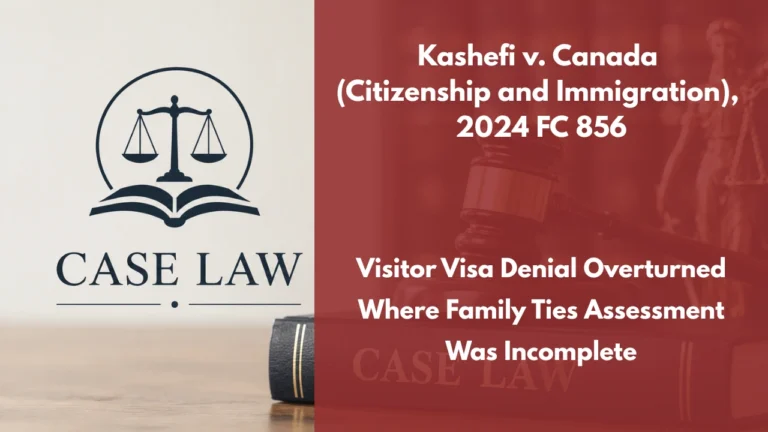
The Federal Court reviewed the
refusal of temporary resident visa applications submitted by a retired married
couple who wished to visit their children and grandchildren in Canada. The
officer concluded that the applicants lacked significant family ties outside
Canada and that the purpose of their visit was inconsistent with a temporary
stay. The Court granted judicial review because the decision letter and GCMS
notes relied on generic and equivocal language without explaining how the
applicants’ specific family, financial, and personal circumstances supported
refusal.
Key Principle
Temporary resident visa reasons
may be brief, but they must demonstrate meaningful engagement with the
applicant’s particular circumstances. Generic statements about family ties,
economic motives, travel history, or socio-economic conditions are insufficient
where the officer does not identify the relevant facts or explain how they
support the conclusion. The Court cannot invent or reconstruct a rationale that
the officer did not provide.
Background
The applicants were retired and
received pensions. They wished to visit their children and grandchildren after
not seeing them for approximately three years.
Their application disclosed that
one child and other relatives remained in their home country, while two
children and grandchildren lived in Canada.
They submitted health insurance,
financial undertakings, and documents showing more than CAD $38,000 available
for the trip and combined annual income of approximately CAD $133,000. Their
children in Canada were also employed.
The officer refused the
applications, citing insufficient family ties outside Canada, limited travel
history, economic or family incentives to remain, and a purpose of visit that
was allegedly inconsistent with a temporary stay.
Court Findings
• Reasons Were Generic
The refusal letter and GCMS notes
contained no meaningful details connecting the applicants’ evidence to the
officer’s conclusions.
• Family-Ties Analysis Was
Equivocal
The officer stated only that
family or economic motives “may” outweigh ties abroad, without making a clear
finding or addressing the child and relatives remaining outside Canada.
• Visit-Purpose Finding Was
Unexplained
The officer did not explain why
visiting children and grandchildren after a lengthy separation was inconsistent
with a temporary stay.
• Socio-Economic Concern Was
Opaque
The reasons did not identify
which aspect of the applicants’ socio-economic situation created concern or how
it supported refusal.
• Court Could Not Supply
Missing Reasons
Although a refusal might have
been reasonably justified on the evidence, the Court could not construct an
explanation that the officer had not provided.
• Updated Evidence Was
Appropriate
Given the passage of time, the
applicants were entitled to provide updated submissions during reconsideration.
Outcome
The Federal Court granted
judicial review, set aside the refusal, and returned the applications to a
different officer for reconsideration with an opportunity to submit updated
evidence. No question was certified.
Case Citation:
Kashefi v. Canada (Citizenship and Immigration), 2024 FC 856 (CanLII)
Prepared by:
Dr. Muhammad
Abrar (Barrister and
Solicitor)
Author | Writer | Mentor | Legal Researcher | Canadian
Immigration Case Law and Statistics Analyst