The Federal Court reviewed the
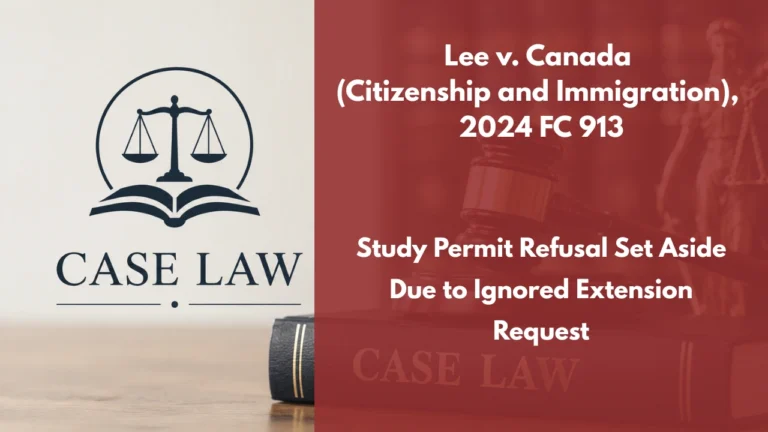
refusal of Aeri Lee’s study permit extension application. IRCC had requested
updated enrolment confirmation and transcripts within ten days. The applicant
submitted some documents and requested a 30-day extension to obtain the
remaining transcripts. The officer refused the application for non-compliance
without addressing the extension request. The Court found that this breached
procedural fairness and that the later reconsideration decision did not cure
the defect.
Key Principle
When an applicant requests a
reasonable extension to respond to a document request, the officer must
consider and decide that request before refusing the application for
non-compliance. A procedural fairness breach may be cured through
reconsideration only if the reconsideration process genuinely addresses the
original defect. The officer must assess the extension request based on the
circumstances existing when it was made, rather than faulting the applicant
months later for not obtaining documents after the application had already been
refused.
Background
The applicant had studied in
Canada under previous study permits and later applied for an extension to
attend St. Michael’s College at the University of Toronto.
On December 2, 2022, IRCC
requested a current enrolment letter and transcripts for all post-secondary
studies in Canada by December 12, 2022.
The applicant requested an
extension until January 12, 2023, explaining that she required more time to
obtain transcripts from three institutions. She submitted one official
transcript and documents concerning a study gap related to mental health
difficulties.
IRCC refused the application on
December 19, 2022, stating that she had not complied with the document request
but making no reference to her extension request.
Court Findings
• Extension Request Was
Ignored
The officer did not acknowledge
or determine the applicant’s request for additional time before refusing the
application.
• Procedural Fairness Was
Breached
Refusing for non-compliance
without addressing a pending extension request denied the applicant a fair
opportunity to provide the requested documents.
• Reconsideration Did Not Cure
the Breach
Although the officer later
acknowledged the extension request, the officer still did not assess whether it
should have been granted when originally submitted.
• Applicant Could Not Be
Faulted for Later Inaction
Once the application had been
refused, it was unreasonable to expect the applicant to spend additional time
and money obtaining official transcripts without knowing whether the file would
be reopened.
• Original Circumstances
Required Assessment
The officer should have
considered whether the requested 30-day extension was reasonable based on the
circumstances existing in December 2022.
Outcome
The Federal Court granted
judicial review, set aside the study permit refusal, and returned the
application to a different officer for redetermination. No question was
certified.
Case Citation:
Lee v. Canada (Citizenship and Immigration), 2024 FC 913 (CanLII)
Prepared by:
Dr. Muhammad
Abrar (Barrister and
Solicitor)
Author | Writer | Mentor | Legal Researcher | Canadian
Immigration Case Law and Statistics Analyst