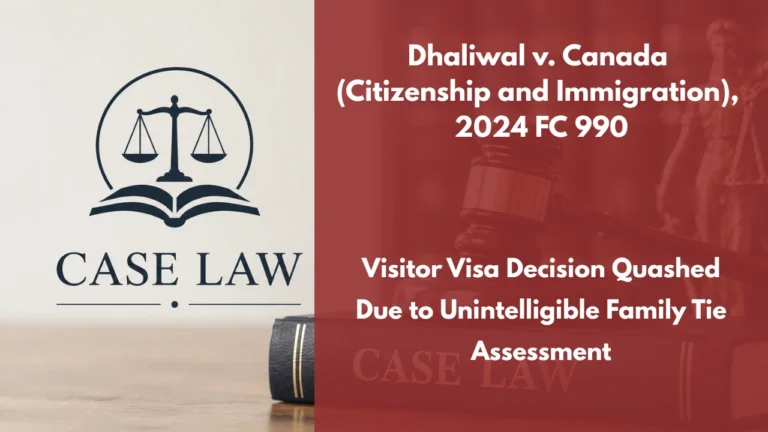
The Federal Court reviewed the
refusal of Sukhram Pal Singh Dhaliwal’s temporary resident visa application.
The applicant sought to visit his critically ill mother, while his spouse and
children also resided in Canada. The officer was not satisfied that he would
leave Canada at the end of his authorized stay, relying on significant family
ties in Canada and a finding that the purpose of travel was inconsistent with a
temporary visit. The Court granted judicial review because the officer’s
reasons contained an unexplained contradiction regarding the existence of those
family relationships.
Key Principle
A visa refusal is unreasonable
where the officer relies on family ties as a significant reason for doubting
temporary intent while simultaneously stating that there is no proof of the
relevant family relationship. The reasons must form an internally coherent and
rational chain of analysis. The government cannot repair contradictory reasons
during judicial review by suggesting that evidence may have existed in another
immigration application when that evidence was not identified in the decision
or contained in the record under review.
Background
The applicant applied for a
temporary resident visa to visit his critically ill mother in Canada.
The officer refused the
application because of the applicant’s significant family ties in Canada and
because the stated purpose of the visit was considered inconsistent with a
temporary stay.
The officer’s notes also stated
that there was no proof establishing the relationship between the applicant and
his mother.
The record contained a marriage
certificate concerning the applicant and his spouse, but no current documentary
evidence confirming the other claimed family relationships beyond the
information listed in the application.
Court Findings
• Reasons Contained an
Internal Contradiction
The officer relied negatively on
significant family ties while also finding that there was no proof of the
relationship with the applicant’s mother.
• Contradiction Was Material
The family ties finding was
central to the conclusion that the applicant would not leave Canada after the
visit.
• Reasons Lacked a Rational
Chain of Analysis
The Court could not understand
how unproven family relationships could simultaneously support the finding of
significant ties in Canada.
• Judicial Review Was Not
Evidence Reweighing
The applicant’s argument
identified a genuine flaw in the officer’s reasoning rather than simply
disagreeing with the weight assigned to the evidence.
• Respondent Could Not
Supplement the Reasons
The suggestion that family ties
may have been established in another refused application amounted to improper
bolstering and did not resolve the contradiction in the decision.
Outcome
The Federal Court granted
judicial review, set aside the temporary resident visa refusal, and returned
the application to a different officer for redetermination. No question was
certified.
Case Citation:
Dhaliwal v. Canada (Citizenship and Immigration), 2024 FC 990 (CanLII)
Prepared by:
Dr. Muhammad
Abrar (Barrister and
Solicitor)
Author | Writer | Mentor | Legal Researcher | Canadian
Immigration Case Law and Statistics Analyst