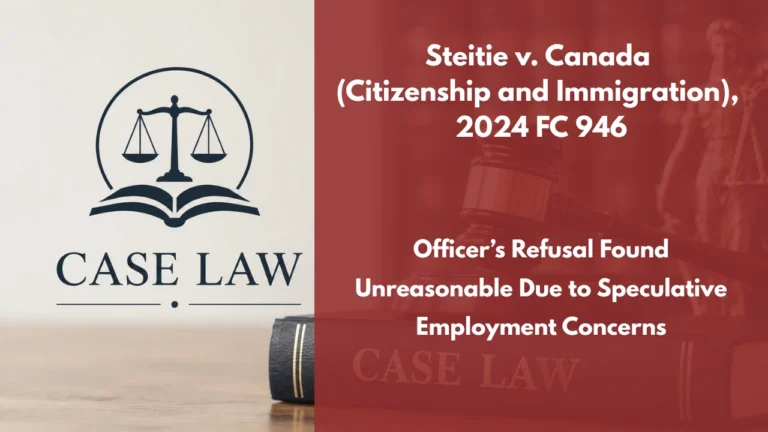
The Federal Court reviewed the
refusal of Omar Steitie’s work permit application as an intra-company
transferee under the International Mobility Program. The officer was not
satisfied that he would leave Canada at the end of his authorized stay, relying
on his immigration status, travel history, finances, employment prospects, and
purpose of visit. The Court found that the officer misapprehended or failed to
engage with key evidence concerning the applicant’s long-term employment,
compliant travel history, family ties, residence, and future position abroad.
Key Principle
A work permit refusal based on
temporary intent must be responsive to the evidence actually submitted. An
officer cannot rely on speculative concerns about future employment, describe a
substantial travel history as limited, or conclude that ties abroad are weak
while ignoring a spouse and minor children who will remain outside Canada.
Where financial documents are not expressly required by the applicable
instructions, an officer should not treat their absence as determinative
without first making the concern clear or requesting evidence.
Background
The applicant had worked in his
family’s heating, ventilation, and air conditioning business since 2010 and was
promoted to General Manager. A related company was incorporated in Ontario, and
he accepted a three-year temporary secondment as its General Manager and
President.
The application included evidence
that he would return to his existing position after the secondment. His wife
and four minor children would remain abroad.
The officer found that his future
employment was insecure because of economic reforms, that his travel history
was limited, that he lacked sufficient personal savings and assets, and that
his ties outside Canada were inadequate.
Court Findings
• Employment Concerns Were
Speculative
The applicant had long-term
employment, a recent promotion, substantial income, and written confirmation
that he would resume his position after the secondment.
• Travel History Was
Mischaracterized
The applicant had complied with
immigration conditions during studies and business travel to several countries.
• Strong Family Ties Were
Ignored
The officer did not meaningfully
address that the applicant’s spouse and four children would remain abroad.
• Financial Requirement Was
Unclear
The applicable instructions did
not expressly require personal savings or asset evidence. If the officer
considered such evidence necessary, the concern should have been clearly
raised.
• Residence Evidence Was
Misunderstood
The applicant had lived abroad
for most of his life and appeared to hold residence independently of the
employment relationship relied upon by the officer.
• Reasons Were Not Responsive
to the Record
The officer’s conclusions did not
form a justified, transparent, or intelligible chain of analysis.
Outcome
The Federal Court granted
judicial review and returned the work permit application to a different officer
for redetermination. No question was asked and no costs were awarded.
Case Citation:
Steitie v. Canada (Citizenship and Immigration), 2024 FC 946 (CanLII)
Prepared by:
Dr. Muhammad
Abrar (Barrister and
Solicitor)
Author | Writer | Mentor | Legal Researcher | Canadian
Immigration Case Law and Statistics Analyst