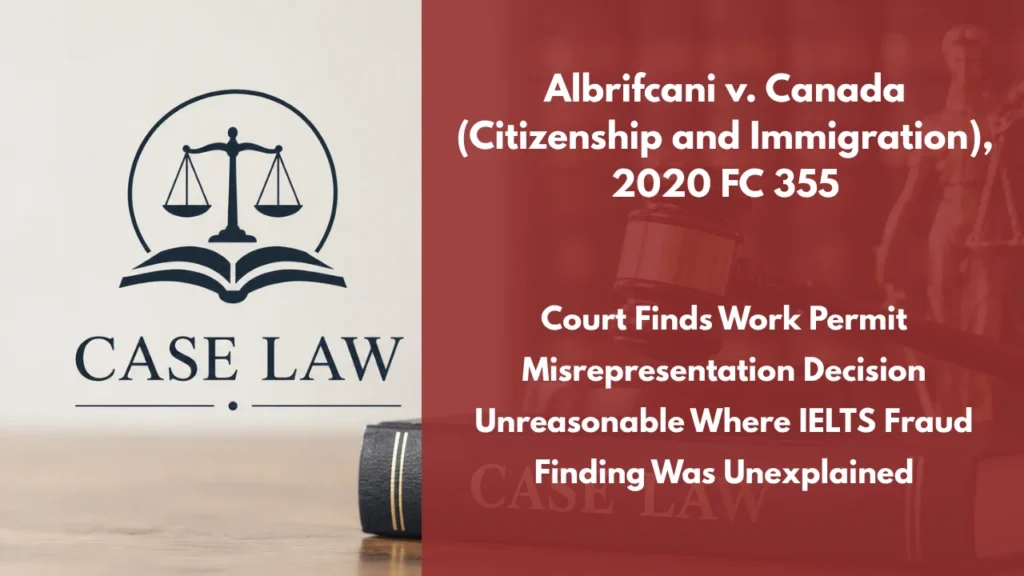
Araz Mohammed Mamdoh Albrifcani
sought judicial review after a visa officer refused his work permit application
and found him inadmissible for five years under paragraph 40(1)(a) of the IRPA
for submitting allegedly fraudulent IELTS results. The Federal Court found the
decision unreasonable because the record did not explain how the IELTS results
were determined to be fraudulent, and the officer’s treatment of Albrifcani’s
response to the procedural fairness letter contradicted what he had actually
stated.
Key Principle
A misrepresentation finding
carrying serious immigration consequences must be justified by the evidence and
intelligible reasons. Where document fraud is established through a
verification process, the record must contain enough information to understand
what was verified and how the verification supported the fraud finding. An
officer must also meaningfully consider an applicant’s response to a procedural
fairness letter and cannot characterize an explanation in a manner inconsistent
with its actual contents.
Background
Albrifcani, an Iraqi citizen,
applied for a work permit in 2018 based on a positive LMIA. Although not
required, he submitted IELTS results obtained after attending an English course
at Modern Up in Duhok City.
A procedural fairness letter
advised him that the officer was concerned the IELTS document was fraudulent.
Albrifcani explained that he paid for the course and examination, received the
results from Modern Up, and believed them genuine. After receiving the letter,
he unsuccessfully attempted to contact the facility and discovered it had
closed.
The GCMS notes stated that a “QA”
had established that the IELTS was fraudulent. They later recorded that
Albrifcani did not appear to deny the fraud and had not explained why he
submitted fraudulent results.
Court Findings
• Fraud Finding Lacked an
Evidentiary Explanation
Nothing in the record explained
what the “QA” was, who conducted it, how it was conducted, or what results
supported the conclusion that the IELTS document was fraudulent. Counsel’s
later explanation that an online verification portal produced no result was not
evidence. The Court held that even brief visa reasons must contain enough
information to justify such a finding.
• Applicant’s Fairness
Response Was Mischaracterized
The Court rejected the officer’s
statement that Albrifcani did not appear to deny the IELTS was fraudulent. His
response expressly stated that he believed the results were genuine and
explained how he obtained them. His later doubts arose only after the fairness
letter and his unsuccessful attempts to contact Modern Up.
The statement that he failed to
explain why he submitted fraudulent results was similarly unintelligible
because it assumed the very fact in dispute. He had explained why he submitted
the results and why he believed they were legitimate.
• Record Raised an Additional
Prejudgment Concern
Although reasonableness was
determinative, the Court also noted possible prejudgment. The fairness letter
stated that Albrifcani’s existing visa and work permit had already been
cancelled before his response was received and considered. This raised a further
concern about whether the outcome had effectively been decided in advance.
Outcome
The Federal Court granted
judicial review because the decision lacked justification, transparency and
intelligibility. No question was certified and no costs were ordered.
Case
Citation:
Albrifcani v. Canada (Citizenship and Immigration), 2020 FC 355 (CanLII)
Prepared by:
Dr. Muhammad Abrar (Barrister and Solicitor)
Author | Writer | Mentor | Legal Researcher | Canadian Immigration Case Law and Statistics Analyst