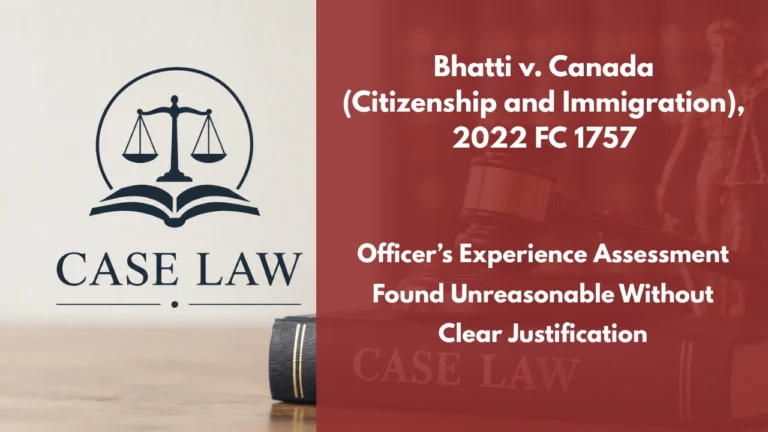
The Federal Court reviewed the
refusal of Anantkumar Bhatti’s LMIA-based work permit for a hairstylist
position. The officer concluded that he had not demonstrated sufficient
experience to perform the proposed work. The Court found the decision unreasonable
and procedurally unfair because central evidence supporting his hairstyling
experience was effectively discounted without adequate explanation.
Key Principle
When an applicant submits
significant evidence directly addressing a disputed qualification, an officer
must explain why that evidence is insufficient. Merely acknowledging important
evidence before reaching the opposite conclusion may render the decision
unreasonable and, where credibility is implicitly questioned without notice,
procedurally unfair.
Background
The applicant obtained a positive
LMIA for a hairstylist position requiring two to three years of experience but
no formal training. He submitted a résumé, a salon letter confirming more than
ten years of work and ownership, sworn client affidavits, training
certificates, and IELTS results. The officer nevertheless concluded that he had
not demonstrated hairstylist experience.
Court Findings
• Sworn Client Affidavits Were
Improperly Discounted
The officer observed that the
affidavits used similar language and were sworn on the same day but did not
explain why those facts diminished their reliability or weight. The Court
emphasized that they were uncontradicted sworn statements from third-party
clients confirming the applicant’s hairstyling work. In the absence of a reason
to doubt them, they were entitled to a presumption of truthfulness and could
not simply be noted and disregarded.
• Salon Letter Directly
Supported the Required Experience
The salon letter confirmed that
the applicant was a partner who had worked there for more than ten years and
described duties including haircuts, colouring, bleaching, treatments, styling,
shampooing, and conditioning. Although the officer acknowledged his ownership
interest, the reasons did not explain what weight was given to this evidence or
why it failed to establish the required occupational experience.
• Insufficiency Finding
Required a Rational Explanation
The officer also acknowledged the
applicant’s training certificates and accepted that practical experience could
substitute for formal education. Despite this, the officer simply concluded
that the applicant lacked sufficient hairstylist experience. The Court held
that because the affidavits and salon letter were central to the disputed
qualification, the officer’s obligation to explain why they were insufficient
was correspondingly greater.
• Treatment of the Evidence
Created a Veiled Credibility Concern
The Court found that unexplained
findings of insufficient evidence can conceal adverse credibility
determinations. Here, the officer effectively rejected sworn third-party
evidence and detailed employment evidence without identifying a substantive
deficiency. If the officer doubted the truthfulness of that material,
procedural fairness required that the applicant be notified of the concern and
given an opportunity to respond.
• Language Concerns Could Not
Preserve the Refusal
The respondent argued that
insufficient language ability could independently justify refusal. The Court
accepted that language might, in another case, provide a standalone basis, but
that was not the decision actually made. Because the officer relied on both
language ability and occupational experience, the unreasonable treatment of the
experience evidence undermined the decision as a whole.
Outcome
The Federal Court granted
judicial review, set aside the work permit refusal, and remitted the
application to a different visa officer for redetermination. No question was
certified.
Case
Citation:
Bhatti v. Canada (Citizenship and Immigration), 2022 FC 1757 (CanLII)
Prepared by:
Dr. Muhammad
Abrar (Barrister and
Solicitor)
Author | Writer | Mentor | Legal Researcher | Canadian
Immigration Case Law and Statistics Analyst